
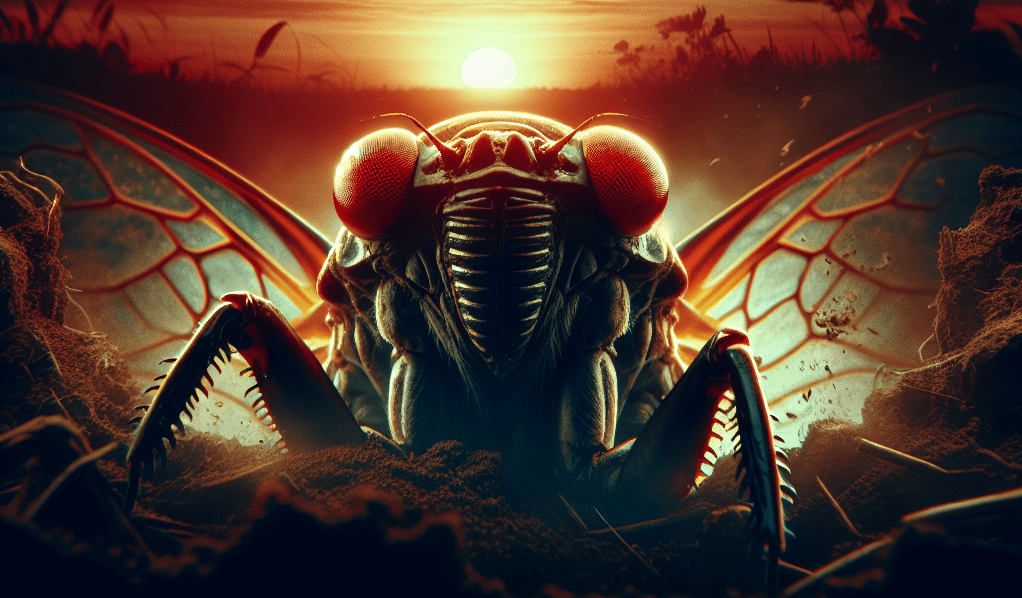
It’s the hottest day of the year, and deep underground, a mysterious countdown has finally hit zero. After years of silence, millions of cicadas are emerging from the earth, ready to take the stage in a once-in-a-lifetime event. But how do these creatures synchronize their grand entrance?
In this episode of The Show About Science, Nate explores the fascinating world of cicadas with Jorin Graham, a physics PhD student from Northwestern University. Together, they dive into the science behind cicada synchronization, the role of xylem in their lifecycle, and how synchronization mechanisms are key in nature.
Connect with The Show About Science:
Instagram: @showaboutscience
Facebook: @theshowaboutscience
YouTube:The Show About Science
Twitter: @natepodcasts
LinkedIn: The Show About Science
Threads: showaboutscience
Transcript
Nate: It is the warmest day of the year so far, and deep, deep underground, something that’s been nearly dormant for years, barely alive, is now stirring, starting to rise out of the soil, clawing its way out of the dirt like a zombie from the grave. And now, all over the Midwest, this creature and its Brethren are taking to the skies and swarming all around us.
Hello, everyone. Welcome to another episode of the show about science. This is your host, Nate. And on today’s episode, we’re talking about cicadas, who, like clockwork, have emerged from the ground again. We’ll discuss what we know and what we don’t know about the magnificent cicada. More on that after the break.
And we’re back with some cicadas. And these are the actual cicadas from my backyard, and hoo boy, you would not believe how loud they are. This one, in particular, flew onto my mic to say hello.
Well, little cicada, thank you for being a guest on the show about science today.
Cicadas, like this one, spend most of their lives living underground, drinking a watery sap called xylem, which is produced by trees. These cicadas are able to tap into the tree’s roots to drink this sap. It’s what’s been keeping them alive while they’re underground. But then, after 13 or 17 years, depending on the brood, they all emerge from the ground at once.
And it’s this massive cicada party. That’s what you’re hearing in my backyard.
And if you’re a cicada, this is the party of your life. You want to be there.
But how do these cicadas spend so much time underground and then all emerge for this massive party within the same month? I mean, how does that happen? And that question is exactly what my guest Jorin has been thinking a lot about.
Jorin Graham: So, my name is Jorin Graham, I am a physics PhD student at Northwestern University, where I apply physics to try to understand biology and ecology better.
Nate: One phenomenon that Jorin thinks may hold some clues to our cicada mystery is something called synchronization.
Jorin Graham: Now, the most familiar example of synchronization is when you go to hear, like, an orchestra, and all of the musicians need to play in the correct time together in order for the piece to come out correctly.
You can imagine what would happen if all of the players didn’t listen to each other, played at their own time. It wouldn’t sound very great, would it?
Nate: Wouldn’t be called a symphony.
Jorin Graham: Exactly, it would be called a cacophony, right? Yeah. Yeah.
Nate: Mm.
Jorin Graham: And in this case, synchronization happens because you have a conductor standing in front of everybody and leading everybody to play together.
A lot of things that are the same doing the same thing at the same time, or a lot of things that are similar doing a similar thing at the same time, like an orchestra, is the type of thing that I study.
Nate: Now, you’re probably wondering, what does a symphony have to do with biology and ecology? Well, it turns out a lot, because in nature, so many things need to work together. And Jorin says this shows up in a lot of different places. Take cells in the human body.
Jorin Graham: The cells have machines inside called proteins that allow the cell to do what it needs to do.
And in this case, you have a lot of different proteins doing a lot of different things, but they have to do them at the correct time in order for things to work together correctly. But there’s other important examples as well. One that I study a lot is actually synchronization between different animal populations.
And this was originally studied by a scientist named Pat Moran in the 1950s.
Nate: And what Pat was studying were Canadian lynx, which are a type of wildcat that lives, as you might guess, in different parts of Canada.
Jorin Graham: And what he noticed is that the populations get larger and smaller in the same years. Now this is interesting because Canada is a big place.
These linked populations are living far away from each other. So how do they manage to grow in the same year or shrink in the same year on a consistent basis?
Nate: To understand that question, let’s go back to that orchestra example. You’ve got different musicians sitting in different parts of the stage.
Jorin Graham: Violins up front. and trumpets in the back. And you can think of one situation where there’s one conductor for the violins and one conductor for the trumpets, and they won’t be playing together because you have two different conductors conducting different rhythms for them.
Nate: Alright, I think you’ll agree. That right there is total cacophony.
So now think of an orchestra the way it normally is, with just one conductor.
Jorin Graham: And in this case, the conductor is going to be conducting both of them at the same time and the violins and trumpets are going to be playing together, even though they’re sitting in different parts of the stage. And that’s how it works for the Canadian Lynx, except instead of having a conductor, you have weather.
And if the weather is similar for the Canadian Lynx living in, you know, two distant parts of Canada, then the populations are going to rise and fall at the same time. But if the Canadian lynx are living in parts of Canada that have different weather, then there’s going to be no mechanism for keeping them in synchronization.
The populations are going to rise and fall at different times.
Nate: In each of these cases, there’s something that tells whatever thing is synchronized that this is the time to do it and you’re all gonna do it. do it at the same time to reach a common function, I guess.
Jorin Graham: Yeah, yes, um, whether it’s an orchestra or the proteins in a cell, when you want things to coordinate, they can’t do this all by themselves, they have to have some way of actually making that coordination happen.
Nate: Yeah.
Jorin Graham: And oftentimes we’re used to that coordination happening because there’s a leader there, like a conductor.
Nate: There’s something that’s, telling all these different components to do this at this time to achieve this outcome.
Jorin Graham: Yes, exactly, exactly. But it turns out that you don’t always need a leader in order to achieve synchronization.
In a lot of other cases, synchronization is achieved just because the different parts of your system can talk to each other. They don’t have a leader, they just talk to each other and they figure it out.
Nate: And now, what you’re saying really reminds me of what I’ve been seeing in my backyard, and what people have been seeing all around the Midwest.
Which is these cicadas, who’ve been in the ground for so long, just all emerging at once. Which, if anything is synchronization, I’d call that synchronization. That is synchronization. Alright, what’s going on here? How are all of these cicadas coming up at basically the same time?
Jorin Graham: Yeah, that’s what got me interested in cicadas in the first place, actually.
And, the answer is also interesting, I would say. The first part, is it seems that individual cicadas actually keep count of the years passing by. Now, the question is, how can cicadas count to 17?
Nate: Yeah, definitely.
Jorin Graham: And the way that scientists think this is happening is because cicadas, When they’re underground, they’re not doing nothing.
During those 17 years underground, they’re eating.
Nate: And what they’re eating, remember, it’s xylem, that sap that’s been keeping them alive underground all this time. Here’s what’s even more interesting about xylem. As the seasons change, the xylem is also changing. Every spring, it’s filled with all these nutrients that aren’t there the rest of the year.
And as this is happening, something may also be happening in the cicadas.
Jorin Graham: What scientists think is happening is that cicadas can actually detect this change in the sap, and so every year when they detect that it’s spring, then they’re like, okay, another year has gone by, and once they count that 17 times, then they come out.
Okay. Now, this is something that we can actually test scientifically, and scientists have done this. You can take two trees, In one tree, the years pass normally, but in the second tree, you can accelerate the season so that it undergoes its growth cycle twice in one year.
Nate: Okay. So, here’s how this experiment worked.
You had two batches of cicadas. You put one on one tree where the seasons would pass normally, and they would end up coming out on year 17. But then you had the other, where you simulated two springs in one year. And on that tree, the cicadas emerged one year earlier, in year 16.
Jorin Graham: And so that’s why we think that cicadas are actually counting to 13 or 17 in order to figure out when to come out.
But there is a problem with this, which is that some cicadas miscount, and they come out at the wrong time.
Nate: And these cicadas that come out too early or too late, they’re known as stragglers.
Jorin Graham: Now this causes a problem, because if those cicadas had children, their children would also come out too early or too late.
And over time, as you had more and more of these stragglers coming out at the wrong time, eventually the cicadas would lose synchronization and we wouldn’t see them coming out every 17 years or every 13 years like we see them doing.
Nate: And the reason these stragglers haven’t been able to alter the 17 or 13 year cycles is because they have the same problem as all of the other periodical cicadas.
Jorin Graham: So it turns out that these cicadas are kind of stupid.
Nate: Okay.
Jorin Graham: They don’t hide very well.
Nate: I’ve noticed, yeah, there was one that, uh, flew into my arm this morning.
Jorin Graham: Exactly, exactly, right? Uh, they, they just kind of sit there, they don’t really, yeah, run away or fly away, they’re really easy to see, and it turns out they’re also really tasty.
Nate: My dogs have noticed that as well.
Jorin Graham: Dogs will eat them, dogs will definitely eat them. Squirrels will eat them. Birds will eat them. Other insects such as wasps will eat them. So they have a lot of predators.
Nate: So everything with a mouth will eat them.
Jorin Graham: Yeah, and so there’s this question of if everything is eating cicadas, how do they survive?
How do they have children, um, so that they like survive the evolutionary game, right? Yeah. And their trick is to come up in such large numbers that no matter how many animals eat them, there’s still more cicadas left. It’s like an all you can eat buffet for all of these animals. They have all the cicadas they want, they get totally filled up, and there’s still tons of cicadas left over.
Nate: Yeah.
Jorin Graham: Now this works really well when all of the cicadas come up at the same time. But if you have a cicada come up in the wrong year, then there’s not that many cicadas around, and they’re likely to get eaten, they won’t have children, and then the cycle is maintained. All of the stragglers just get eaten.
Nate: And so then, there’s one last thing that we haven’t talked about yet, which is, there’s also annual cicadas, which are cicadas that emerge from the ground year after year after year.
Jorin Graham: Yes, so the annual cicadas, to be a little bit more specific here, uh, because we’ve been talking a lot about periodical cicadas.
The difference between periodical and annual cicadas is that the periodical cicadas are synchronized and the annual cicadas aren’t. So both annual cicadas and periodical cicadas have a lifespan that’s more than one year, but the difference is that annual cicadas come out of the ground once they’re all grown up and once they’re all mature.
They don’t coordinate their emergence. They come out when they’re ready.
Nate: And so then, How is it that these annual cicadas evolved in one direction and then the periodical cicadas evolved in a completely different way?
Jorin Graham: So scientists have been really interested in this question and they’ve come up with a lot of different theories for All the different sorts of pressures that could actually cause cicadas to evolve these periodical patterns and also trying to come up with ideas for why this didn’t also pressure annual cicadas to do the same thing.
And the truth is that nobody knows the exact answer, but we do have some clues.
One clue is that annual cicadas are actually better at avoiding predators than these periodical cicadas.
Nate: Okay.
Jorin Graham: And so one thought is that a big reason why these periodical cicadas have evolved the synchronized life cycle is that that’s their way of Surviving Predation, uh, whereas other cicadas have come up with alternate strategies, in particular, they just avoid getting eaten in the first place.
Nate: Okay. Essentially, it’s either these periodical cicadas have evolved this, I guess, defense mechanism of waiting and then all coming up at the same time, en masse. to breed and reproduce, and like, some will get eaten, but some will survive. They’ve come up with that strategy, and then these other cicadas have instead just actually become able to, I guess, defend themselves from predators or run away.
Essentially, they’ve become not stupid.
Jorin Graham: Exactly, exactly. I think what’s interesting is that both of these strategies currently, like, co exist. Like, we have both annual cicadas and periodical cicadas living in the same place. So, so far, both of these seem to be valid strategies to win at the evolutionary game.
Nate: So, it’s been a few weeks since recording this interview, and I’m out here in my backyard again, and the whole party, like clockwork, is over. To all of you little baby cicadas in the ground. Synchronization is a winning strategy, and you need all of you to survive. So, drink your xylem, and we’ll see you again in another 13 or 17 years.
There you have it, folks. The show about science is complete. Thank you so much, Jorin, for coming out to the show about science studio, and for just being a great guest. Additional production and editing comes from Tim Howard in Berlin. Music on today’s episode comes from Epidemic Sound, and our theme music was produced by Jeff, Dan, and Teresa Brooks.
For ad free listening and transcriptions of all of our episodes, check out theshowaboutscience. com. See you guys on the next episode, and Dad, you can shut the recording off.
 The Show About Science
Leave a comment