

What is it like to fly a plane while attempting to make a podcast from 2,000 feet in the air? And can we pull this off?
In this episode of The Show About Science, Nate chats with Carley Walker, the Director of Development at STEM Flights, and then takes to the skies with STEM Flights volunteer, Dragan Lazić, a passionate pilot and aviation safety expert. Nate’s thrilling flight experience at Waukegan National Airport highlights the importance of STEM education and programs like STEM Flights, which inspire young people to explore aviation and STEM careers.
STEM Flights is a national nonprofit organization that connects Middle and High School students with volunteer Pilot Mentors to inspire America’s youth to pursue STEM and aviation careers with a unique flight experience.
Learn more about STEM Flights: www.stemflights.org/
Apply to fly a STEM Flights mission: www.stemflights.org/applyforastemflightLearn more about Dragan and Golden Wings Team: www.goldenwingsteam.com/
T-Shirt Contest
The first 3 listeners who subscribe to The Show About Science mailing list will receive a Show About Science Flight Crew T-Shirt.

To enter, subscribe to our mailing list here: theshowaboutscience.com/#subscribe-email and then emails us at showaboutscience@gmail.com.
Connect with The Show About Science:
Instagram: @showaboutscience
Facebook: @theshowaboutscience
YouTube:The Show About Science
Twitter: @natepodcasts
LinkedIn: The Show About Science
Threads: showaboutscience
Transcript
Nate: I mean, it’s kind of funny because nervousness is coming in waves. It’ll hit me and then recede and then I’m really excited. So right now I’m really excited. But yeah, it is a little nerve-wracking but it’s gonna be so cool.
Welcome back to the show about science. This is your host Nate. And you’re probably wondering, why am I so nervous? Well, I’m about to see what it’s like to fly a plane. And I’m going to attempt to make this episode from 2,000 feet in the air. Are we going to pull this off? There’s only one way to find out and that’s to keep listening.
I’m here at the Waukegan National Airport to meet up with a pilot and aviation safety expert named Dragan. Not “Dragon” like Game of Thrones, but Dragan.
Dragan Lazić: Dragan in Serbian language that means something is like a honey guy or something like that, you know.
Nate: You know, sweetheart, honey, that sort of thing. And he really is an awesome and very interesting guy.
Dragan grew up in Serbia and has been flying for most of his life.
Dragan Lazić: When I flew for the first time, I was seven and a half.
Nate: He now lives just outside of Chicago.
Dragan Lazić: I moved from 2014 from Serbia to here.
Nate: And he’s the founder of Golden Wings Team, a company that trains aspiring pilots. And I’ve never met someone more passionate about aviation.
He could talk for days and days about it.
Dragan Lazić: To become a pilot, airline pilot, we need to receive good knowledge and experience that we can start with. Not to become an airline pilot.
Nate: Dragan says he can trace his love of planes back to one moment when he was a kid.
One day, when he was about five years old, living in a small town in Serbia, a pilot flew over his house.
Dragan Lazić: Military pilot, fighter pilot, and he flew above our houses.
Nate: And everybody in the town was really excited to see this plane.
Dragan Lazić: That fighter pilot, when he flew above our houses, I saw happiness.
Nate: Then a sonic boom from the jet shattered all of the windows in his house.
And he was in awe.
Dragan Lazić: Because that was like, wow, what’s this?
Nate: In fact, they shattered all of the windows in all of the homes in his town. And you would think that everybody in the town would have been upset, but…
Dragan Lazić: No, no, no one,
Nate: no one. So everybody was amazed by the power of the jet.
Dragan Lazić: Everyone was happy to see that.
Even they don’t have windows after that flight. They were happy. And that moment when I see that happiness in people, and I say, “Oh, okay, I would like to do the same thing.”
Nate: Everybody else in the town fixed their windows. But that window in Dragan’s room at his parents’ house, it’s still broken.
Dragan Lazić: Yeah, and we don’t change that window because I don’t like to change that yet.
Nate: In honor of that day, he decided to never fix it.
Dragan Lazić: That moment is alive inside of me. From that moment until now, and I think it will be always in my life.
Nate: Nowadays, as an instructor and experienced pilot, Dragan wants to give people the same feeling of awe that he had as a kid when the fighter pilot flew overhead. And as it turns out, he’s not alone.
Carley Walker: Pilots really want to give back, and they want to inspire the next generation. And if you give pilots a mission, they want to fly that mission.
Nate: This is Carly Walker, and she helped her dad, General Dave Brubaker, found a program called STEM flights.
Carley Walker: I helped Dad, you know, kind of figure out, “How can we get kids all over the United States flying?”
Nate: Gen Bru, as he was affectionately nicknamed, was an F-16 fighter pilot, and he loved flying. But even more than that, he loved taking kids on their first flight.
Carley Walker: He was giving flights to kids for the last 20 years, and sometimes they would come back to him and say, “That flight was so inspiring to me. I just have to let you know how it changed my life.” And when he retired, he thought, “How can we reach more kids all over the United States, get them in airplanes, and inspire them to pursue STEM careers?”
And that’s really where STEM flights was born.
Nate: That was back in 2018, and things started taking off pretty quickly. What really started happening that was absolutely amazing was pilots from all over the country started signing up. Then kids started applying to fly STEM missions, first in Virginia, then across the East Coast, and it spread quickly from there.
They’ve now flown STEM missions in 48 states.
Carley Walker: The only two states I’m missing, Nate, is Alaska, so if you know any kids up there, I would love to meet them. And North Dakota, for some reason, those two states are our biggest holdouts, but we’re going to get those done this year.
Nate: STEM flights has grown into a nationwide organization that matches kids with pilot mentors.
And along the way, kids can learn about things like aviation, aerospace engineering, drones, physics, environmental science, and weather. Anyone can apply, and it’s free.
Carley Walker: So the flight experience is where the fun begins, right? So you take all this learning that you’ve already done, you do the homework, you do the mission, and then you take it to the airport, and that’s where things get cool.
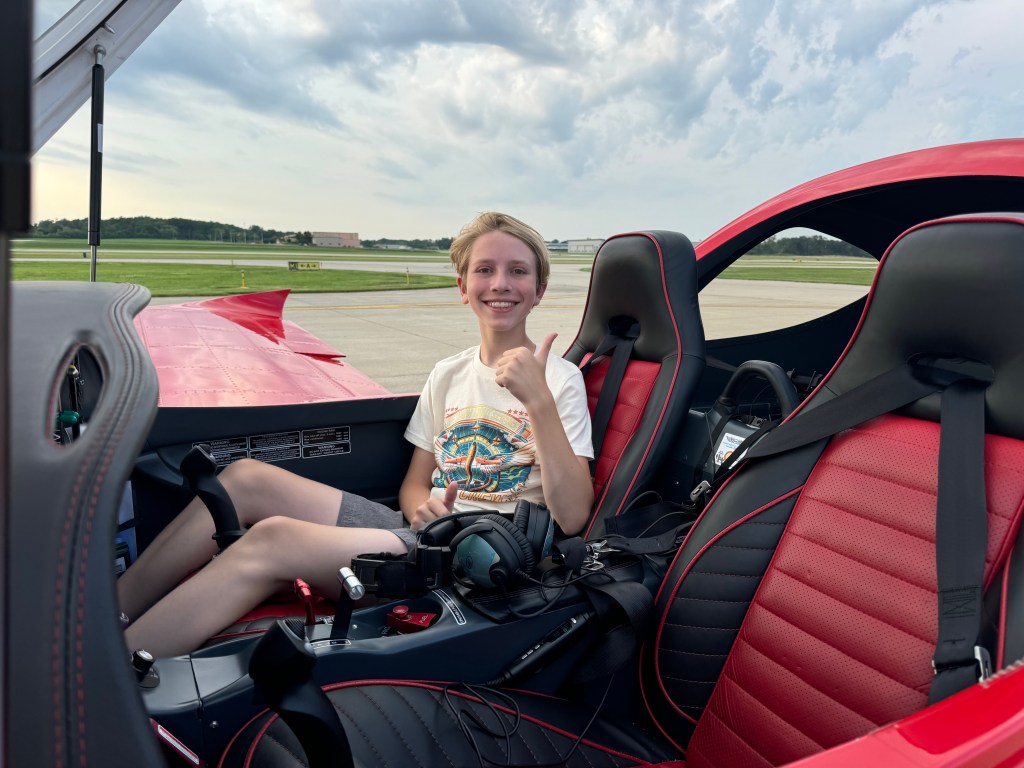
Nate: I’ve always thought that flying a plane would be super cool, so I applied. Dragan wanted to share that joy he experienced as a kid with others, so he volunteered as a STEM flights pilot. And that’s how the two of us came to be sitting on a runway together in his gray and red lightweight airplane, ready for takeoff.
Air Traffic Control: Crystal 793.1 Kilo, Waukegan ground from the South Ram, runway 5, taxi via Alpha.
Dragan Lazić: How do you feel now?
Nate: I’m excited. Let’s take to the skies.
Dragan Lazić: Yep.
Nate: Inside of the cockpit, there were hundreds of buttons and switches, a couple screens, and then two joysticks, one for me and one for Dragan.
Dragan Lazić: Flight controls, check, and we will check fuel pump.
Nate: We did a quick engine check.
Dragan Lazić: Ok.
Nate: All right, engine check’s done. We’re all good?
Dragan Lazić: All good. We will set up here a flap stand, and then we will switch now to COM1.
Nate: All that was standing between me and the sky was a long stretch of runway.
Dragan Lazić: Waukegan tower, good day, Bristol 793 on code Alpha.
Nate: And then air traffic control came in.
Air Traffic Control: Bristol 793.1 Kilo, Waukegan tower, runway 5, clear for takeoff, make a right turn to the southwest. Okay, ready?
Nate: All right.
Dragan Lazić: Ok.
Nate: We were clear for takeoff.
Here we go.
Dragan Lazić: You’ll see now how takeoff looks.
Nate: We started accelerating, and my heart was pounding. And we were going faster and faster, and I was nervous, but excited, but nervous. And then… Oh, wow. All right.
Dragan Lazić: Yeah, that’s good.
Nate: Just like that. All right, we’re in the air. We were in the air.
Dragan Lazić: Okay, how do you feel now?
Nate: Feels pretty cool.
And it was incredible.
Dragan Lazić: That’s the idea with small airplanes. You can feel everything.
Nate: Yeah.
Dragan Lazić: Oh, okay. We have some wind here. You can see.
Nate: Yeah.
Dragan Lazić: Huh?
Nate: Oh, yeah, you really can feel everything. That’s kind of crazy. All of the little back and forth movements of the plane, I could feel in my stomach. It was kind of like the dropout on a roller coaster, only this was for real.
And then we made a turn, and there was Lake Michigan. Oh, and we can see the lake from here.
Dragan Lazić: Yeah, oh, yes, yes. Wow. Now you will see everything. Oh, yeah.
Nate: The moment I was in the air, all of the nervousness just evaporated.
And it was amazing.
Dragan Lazić: How do you feel now?
Nate: I feel very cool. Okay. This is awesome.
Dragan Lazić: Uh-huh. Once we’re out of the airport, I will give you controls, and you can try to fly a little bit.
Nate: Okay, sounds good. I looked out the window, and I could see these places that I was so familiar with, but they looked totally different.
Beneath us was one of my favorite amusement parks with roller coasters and rides.
Dragan Lazić: Can you see over there? There are Six Flags.
Nate: Whoa.
Dragan Lazić: We will fly now over there.
Nate: Yeah, on those roller coasters you feel so high, but we are higher now.
Dragan Lazić: Let’s plan to go to 2000.
Nate: Okay. As we were ascending, I couldn’t help but think, I must be one of the few podcasters to ever record an episode 2000 feet in the air. I mean, how cool is that?
Then when we reached our cruising altitude, Dragan handed off the controls, and it was my turn to fly the plane.
Dragan Lazić: Okay, let’s get controls now with the hand. Only one. Okay.
Nate: Dragan gave me some brief instructions. If you go forward, you go down. If you pull back, you go up.
Dragan Lazić: You have to stay here on the horizon.
Can you do that? Okay. At first, it was tricky. Oh, we have some bumps. Did you feel that?
Nate: I did, yeah. I was struggling a little to keep us on the horizon, going straight at the exact right angle. I feel like I’m a little choppy, but so far we’re staying on the horizon.
Dragan Lazić: Let’s go a little bit over there north.
Nate: Okay. I definitely felt like I was making a few mistakes at the beginning, but as the flight went on, I could feel I was getting more comfortable with the controls. Wow, steering the plane. That’s crazy. I was in control, and that was an incredible feeling.
Dragan Lazić: You can see. You control the airplane. Yeah. You’re flying good.
Nate: But just like that, it was time to land.
Dragan Lazić: And you see a runway in front of us? I do, yes. Okay.
Nate: I was supposed to start our descent, but I was a little afraid to push too far down on the controls, just in case we’d start spiraling or something. So this was probably the biggest mistake I made, and it meant that we were slightly too high when it came time to land.
But I made some adjustments, started our descent, and gave the controls back to Waukegan, because obviously I’m not capable of landing a plane yet.
Dragan Lazić: You will land once you start to training.
Nate: Right. We requested permission to land.
Air Traffic Control: 731 Kilo, Waukegan Tower, runway 5, good to land.
Nate: Dragan lined up the airplane.
Alright, coming in to land.
Dragan Lazić: Did you feel that?
Nate: And there we go, we’re on the ground.
Dragan Lazić: Yeah.
Can you feel that? No bumps, no nothing.
Nate: Yeah, that was a good landing.
Dragan Lazić: I told you.
Nate: That was awesome.
Dragan Lazić: Thank you for a good flight.
Nate: Yeah, thank you for letting me take the controls.
After the flight, Waukegan told me something that I can’t stop thinking about. He said being a pilot is more than just flying a plane.
Dragan Lazić: This is a very important thing. People like to say, pilots like to say, we are always kids. Why? Because kids doing mistakes, they don’t stop because they made mistakes. They just continue to do their stuff, you know, and growing.
And the pilots are doing the same things. We make mistakes, but if we practice more, more, more, we make smaller mistakes and that’s the way to become a better, not just a pilot, people.
Nate: In life, we make mistakes, we improve, but none of this happens if we don’t try. And STEM flights lets you try.
Carley Walker: So, Nate, I got to say, especially to those that might be listening, sometimes when kids can get up in an airplane and they can see their school and their house and their town, that experience can be really life-changing for young people.
Nate: Again, this is Carly Walker.
Carley Walker: And they understand that the world is bigger than maybe they can comprehend when you’re on the ground. And you get a sense of a bigger picture and that’s harder for young people to grasp because you’re still young, you’re still learning, you’re still growing up. And so when you can get a young person up in that airplane, it can be really, really, really inspiring.
And I would just encourage kids out there, even if you don’t think you have a huge interest in aviation or aerospace, you might really love this program and you might learn about some different careers or some different opportunities that you didn’t know before.
Nate: STEMflights.org, go give them a try.
There you have it, folks. The show about science is complete. So many people to thank for this episode. First, Carly and Maria at STEMflights. This episode wouldn’t have been possible without you. Thanks for inspiring so many kids to reach forthe sky. [SPEAKING IN SERBIAN]
Production and editing support comes from Tim Howard in Berlin. [SPEAKING IN GERMAN]
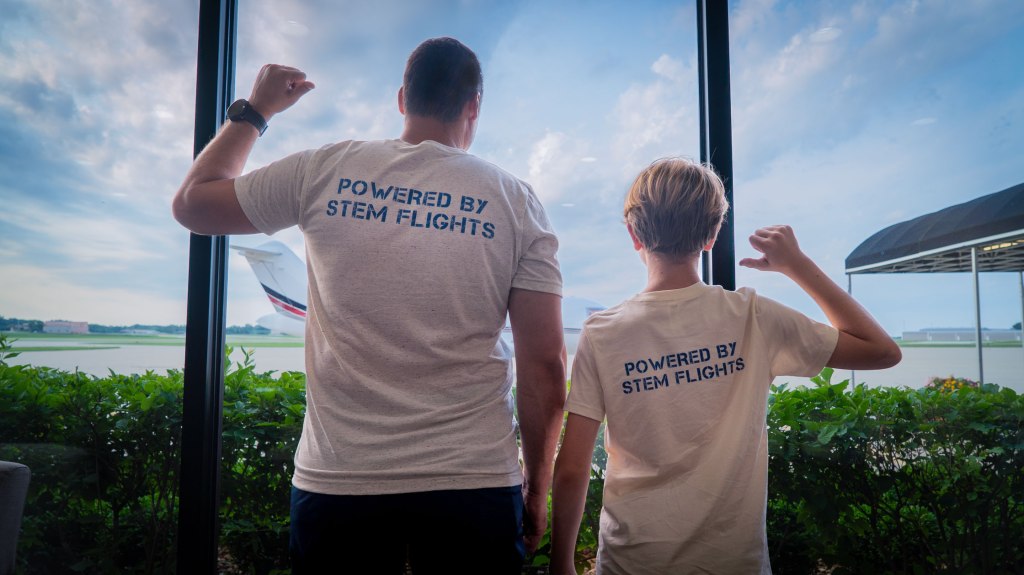
We made some really cool Show About Science flight crew T-shirts for this episode. The first three people that sign up for our mailing list will get one of these shirts sent to you. Details are in the description and you can see what those shirts look like over at theshowaboutscience.com.
Music on this episode comes from Blue Dot Sessions and Epidemic Sound. And as always, our theme song was written by Jeff, Dan, and Theresa Brooks. OK, Dad, you can shut the recording off.
 The Show About Science
Leave a comment