

Seeds hold history. They carry the genetic blueprints of the past and the key to our future. But when disaster strikes, how far will scientists go to save them before they’re lost forever?
In this episode of The Show About Science, Nate traces the incredible journey of some of the world’s most valuable seeds – from the Middle East to the Arctic Circle to the wheat fields of Kansas. Along the way, he uncovers how a global network of scientists are racing against time to safeguard our food supply for generations to come.
Joining us on this journey are Mark Schapiro, author of Seeds of Resistance: The Fight to Save Our Food Supply, Luigi Guarino from the Crop Trust, Zakaria Kehel from the International Center for Agricultural Research in the Dry Areas (ICARDA), and Bart Panis from the World Banana Collection.
Want to see inside the Svalbard Seed Vault? Check out the virtual tour here: https://seedvaultvirtualtour.com/.
Connect with The Show About Science:
Instagram: @showaboutscience
Facebook: @theshowaboutscience
YouTube:The Show About Science
Twitter: @natepodcasts
LinkedIn: The Show About Science
Threads: showaboutscience
Transcript
Nate: If you Google the banana capital of the world, you’ll get a couple of different answers.
Sunny, tropical places like Central and South America, Southeast Asia, or the Caribbean.
But if you ask me, I think it’s actually located in the cold, northern European country of Belgium.
Bart Panis: About 30 kilometers from Brussels.
Nate: In a place called Leuven.
Leuven is a beautiful, historic European city.
Bart Panis: With some nice old buildings.
Nate: There’s cobblestone streets.
Bart Panis: We have castles.
It’s nice to live there, yeah.
Nate: And it’s one of the few places in the world where every known species of banana can be found.
Which is kind of weird, because bananas don’t even grow in Leuven.
Bart Panis: Yeah, we are in Belgium.
And you come in contact with bananas only when you go to the supermarkets.
But we conserve the big diversity of bananas that we have here in a lab in test tubes.
Nate: This is Bart Panis.
Bart Panis: I am the gene bank manager of the World Banana Collection.
Nate: The World Banana Collection is what’s known as a gene bank.
And it’s home to, get this, nearly 1,700 different types of bananas.
Bart Panis: And each variety is represented by 20 test tubes.
Nate: That’s over 34,000 test tubes packed on shelves in a massive room.


Bart Panis: What they call a cold room. It’s 15 degrees Celsius.
Which is for bananas, very cold.
I don’t know how much is in Fahrenheit. This is up to you to calculate.
Nate: That’s about 60 degrees Fahrenheit.
Bart Panis: And this is cold enough to slow down the growth of these plants.
Nate: Slowing down growth keeps the plants alive, but in a kind of suspended animation.
So they can be preserved and then regrown when needed.
Bart Panis: Correct.
And in the basement we have an extra collection, which is a backup.
Nate: The backup in the basement is kept at freezing temperatures, preserving the bananas for essentially eternity.
And there’s another backup of the whole building in the south of France.
But why so many backups for bananas?
Bart Panis: So it’s a security of a security because we are conserving all the bananas.
We cannot play around with it. If they are lost, they are lost forever.
Nate: Banana varieties have been lost to disease before. And it could happen again.
But here’s the thing. It’s not just bananas.
Every plant we eat is facing some sort of threat. Diseases, drought, climate change, disasters.
That’s where gene banks come in.
Across the globe, there’s this network of gene banks where scientists, like Bart, are actively working to protect our food supply.
Bart Panis: Exactly. It’s an insurance. An insurance.
Nate: Gene banks preserve seeds and plant material so they can be regrown, studied, and used to breed more resilient crops.
And if anything goes wrong in a farmer’s field, the biodiversity in gene banks are their insurance policy for the future.
Without these gene banks, once a crop is lost, it’s potentially lost for good.
Not too long ago, some of the most important seeds in human history were in jeopardy.
Today, I want to tell you that story. How a seed bank in the Middle East came under attack, and the extraordinary backup plan scientists put into motion to safeguard these seeds.
I’m Nate, this is the show about science, and our journey starts right after the break.
Nate: Alright, so now it should be recording.
We’re going to start our story in Iraq.
Mark Schapiro: Okay. Okay.
Nate: In a city called Abu Ghraib.
Nate: Yeah, let’s just jump in.
Mark Schapiro: And Abu Ghraib, most people are going to remember as the site of this terrible prison, but what was also in Abu Ghraib was a seed bank.
Nate: This is Mark Schapiro, environmental journalist, professor at UC Berkeley, and author of the book Seeds of Resistance, the Fight to Save Our Food Supply.
The seed bank we’re talking about was called the Iraqi National Seed Bank, and it was located right in the middle of a historically important region, the Fertile Crescent.
Mark Schapiro: Which you may remember from your geography classes was often seen as the birthplace of agriculture.
Nate: For over 10,000 years, humans cultivated and improved the seeds in this area.
They grew all sorts of varieties of barley, fava beans, chickpeas, lentils, and wheat.
For decades, Iraqi scientists collected these seeds, creating one of the world’s oldest and most valuable seed collections.
And what made these seeds so valuable were the genetic blueprints for survival inside.
In his book, Mark says that just like humans carry the DNA of our ancestors, the seeds at Abu Ghraib were a sort of living archive of genetic diversity.
Ancient, tough DNA that could be bred with modern crops to make them stronger and better.
And everything was fine until the U.S. invaded Iraq in 2003, and the bombs started to fall.
Mark Schapiro: Some of your listeners might recall the United States invaded Iraq in 2003 to dislodge the dictator in Iraq at that time.
Nate: Suddenly, this seed bank became caught in the crosshairs of a war it wasn’t prepared for.
First came the looters.
They broke in, dumped the seeds from their containers, and stole the glass jars.
Mark Schapiro: Many of the seeds just ended up on the floor.
Nate: These scientists had to make a decision, and they had to make it fast.
Would they risk their own lives to save these seeds?
Mark Schapiro: What was amazing was all these scientists gathered together and went to that seed bank, collected what they could off the floor.
Nate: They scooped up what they could into makeshift containers, climbed into open pickup trucks, and started driving west.
Mark Schapiro: They kind of raced across the border from Iraq into Syria to Aleppo.
Nate: As they crossed the border, more bombs began to fall.
This time, one hit the seed bank.
Mark Schapiro: Probably by mistake, but nevertheless it was bombed and destroyed.
Nate: But the scientists could finally breathe a sigh of relief.
They found a new home at the International Center for Agriculture in Dry Areas, or ICARDA.
Mark Schapiro: ICARDA welcomed this troop of scientists with these important seeds and added them to the existing seed collection.
So now ICARDA has some of the most important seeds really in the world for researching agriculture in dry areas.
Nate: After the bombing of the Iraqi seed bank, they knew anything could happen.
ICARDA’s collection had to be protected.
They didn’t just need a backup plan.
They needed a vault.
A place where these valuable seeds would always be safe.
And it wasn’t just ICARDA.
The whole global network of seed banks needed somewhere to back up their entire collections.
Then, in 2008, came the solution.
The Svalbard Global Seed Vault, located on the remote Norwegian island of Svalbard, just north of the Arctic Circle.
It’s not quite the top of the world, but it’s pretty close.
Luigi Guarino: It’s as far north of Oslo as Oslo is north of Rome.
So you do go quite a ways north.
And Oslo is pretty north, right?
Nate: Oh yeah.
Luigi Guarino: And I think it’s the furthest north that a commercial flight goes in the world.
Nate: This is Luigi Guarino, chief scientist at the Global Crop Diversity Trust, which is the organization that oversees the Svalbard Seed Vault.
And he’s part of that global network of scientists protecting our food supply.
Have you ever actually been to the Svalbard Seed Vault?
Luigi Guarino: Yeah, I was there once.
Nate: Can you describe what that was like?
Luigi Guarino: So you land in a place called Longyearbyen.

There’s a small airport there that’s right on the fjord.
You can see the vault from the airport.
It’s a beautiful place.
The wildlife is interesting.
There’s polar bears that occasionally even come into town, apparently.
Thankfully it didn’t happen while I was there.
Nate: Hopefully they don’t take interest in any of the seeds.
Luigi Guarino: I think they would have trouble getting into the door.
Nate: Yeah, for anybody who hasn’t seen that entrance, it just looks like a door that’s slowly descending into a mountain.
It’s crazy looking.
Luigi Guarino: Yeah, you’re right.
So that’s the iconic entrance, which goes into the mountain.
You go in there and then you have to put on a hard hat.
Nate: Apparently to protect you from any loose ice that might fall from the ceiling.
Luigi Guarino: And then you walk down this tunnel, which goes about 100 meters into the mountain.
And then you end up in this huge kind of cavern in the middle of the mountain.
Some people call it the cathedral.
Nate: The cathedral gets its name from the high arch ceiling.
The walls are all exposed rock covered in frost and ice.
Luigi Guarino: And then there’s another door, then you go into the actual vault where the seeds are kept.
Nate: Inside there are rows of metal shelves, kind of like the shelves you’d see in a Home Depot.
On each shelf, stacked from floor to ceiling, are heavy-duty plastic waterproof bins holding hundreds of foil seed packets.
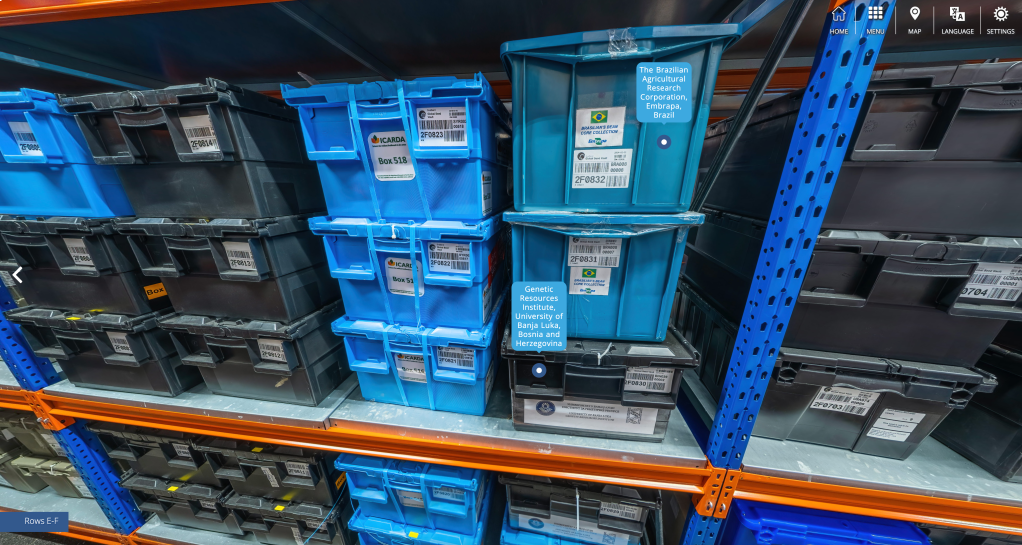
Luigi Guarino: And in one relatively confined small place, they represent the heritage of thousands of years of agriculture all around the world.
And there you will have boxes from North and South Korea side by side.
You have all the countries of the world there represented, ensuring that humanity as a whole survives.
Nate: Saving humanity sounds like something straight out of a Hollywood movie, right?
And that’s earned Svalbard a pretty dramatic nickname.
News Clips: What if all plants on Earth went extinct?
The answer to this question lies in Norway’s top secret doomsday vault.
This is the doomsday seed vault.
Often called the doomsday vault, it is used as a last resort in case a region suffers from a catastrophic event, wiping out its food supply.
No seeds have ever been removed from the vault.
Luigi Guarino: Well, we try not to call it the doomsday vault ourselves.
That’s a name that was given to it by the press because people imagine that come the zombie apocalypse or something, we’ll have to restart agriculture and we’ll need seeds from somewhere and we’ll go to the Svalbard global seed vault and get seeds out of the permafrost and restart global agriculture from the seeds in the vault.
That’s not really why it’s there.
It’s not really doomsday in the sense of, you know, worldwide catastrophe.
But if you have a doomsday in your gene bank, you can go to the vault and get a copy of your seeds back and reestablish the research program or the breeding program that you were using those seeds to do.
Nate: Okay, so the Svalbard seed vault isn’t there in case of a global catastrophe.
It’s just there so that all of these different seed banks or research institutions around the world can have a stable stockpile of different genes within these crop species that they could fall back out if their supply dwindles for some reason.
Luigi Guarino: Right, right, right.
Nate: Would you say that’s correct?
Luigi Guarino: That’s correct.
Well, I’ll give you a concrete example. Just outside Aleppo in Syria, there was a large gene bank.
Nate: The same gene bank we were talking about earlier, ICARDA.
Luigi Guarino: As you know, a few years ago the Syrian war broke out and researchers that were working in Aleppo had to leave the premises.
Nate: Luigi says that war had once again come for these seeds.
But this time, as the bombs shook the seed bank in Aleppo, heavy-duty waterproof bins, stamped with the ICARDA logo, sat safe in Svalbard’s permafrost.
Luigi Guarino: They are taking the precaution of making copies of all the seeds and storing them elsewhere, including at the Svalbard Global Seed Vault.
Nate: Most of the collection was backed up, but not all.
According to Mark Schapiro, 15% remained unprotected, and now the scientists needed to act.
Mark Schapiro: A number of scientists race over to the ICARDA station in the midst of the bombardments by the Assad government and collect as many seeds as they can, thousands of seeds.
Nate: The race was on for ICARDA to get these seeds out again.
Mark Schapiro: They put them in containers at the back of open pickup trucks, as it was described to me, and essentially raced them across the border towards Lebanon.
They had to pass through numerous checkpoints along these very contested highways, rebel checkpoints, government checkpoints, and finally through Hezbollah checkpoints.
But because they’re carrying seeds, they’re allowed to pass through.
Nate: Mark says that when they arrived in Lebanon, they were greeted by the head of ICARDA’s research operations.
Mark Schapiro: A man named Ahmed Amri, and he greets this shipment of seeds, refugee seeds, I called them, and installs them in the seed bank in Lebanon.
Nate: The seed bank in Aleppo was damaged, its future uncertain, but the seeds were safe.
Now came a new challenge.
The rest of the seeds were still up in Svalbard, locked away in an Arctic mountain.
No one had ever needed to withdraw seeds from the vault before.
It was meant as a last resort, an insurance policy for the future.
But now for ICARDA, the future had arrived.
And for the first time in history, a seed bank had to make a withdrawal.
Would these frozen seeds, sealed away for years, actually grow?
We’ll find out right after the break.
Nate: And we’re back.
All right, so when ICARDA left Aleppo, they relocated to two locations.
The one in Lebanon that you just heard about, and another in Morocco.
Their first task was retrieving the seeds from the vault in Svalbard.
But the scientists were afraid.
Could these tiny packets, frozen in permafrost for years, still grow?
Zakaria Kehel: Imagine I bring in all the seeds, and it does not germinate. That’s really the fear that everybody has.
Nate: This is Zakaria Kehel.
He’s a researcher at ICARDA based out of Morocco.
And he’s part of that global network of scientists protecting our food supply.
And there’s a video on YouTube showing one of his colleagues opening the first box arriving at ICARDA.
ICARDA Researcher: After so long a distance, so many years sealed in these aluminum foils, let’s check the seeds.
Nate: The researcher opens the box, takes out a foil packet containing some seeds.
He opens it and empties the seeds into his hand.
Then you see his face.
And he’s got the biggest smile.
ICARDA Researcher: Perfect. Very happy. Very happy.
Nate: Now came the hard part, regenerating the collection.
ICARDA immediately got to work.
They grew new plants, harvested the seeds, prepared and packaged them for long-term storage.
And then they made extra copies.
Zakaria Kehel: The first thing we do is secure two copies for safety duplication. We learn from the past.
Nate: They kept at it, regenerating the seeds from Svalbard one foil packet at a time.
Slow, meticulous work. Open the packet, inspect the seeds.
ICARDA Researcher: Perfect. Very happy.
Nate: Then plant, grow, harvest, package. Make a backup. Do it again. A year went by.
Zakaria Kehel: We don’t say we regenerate successfully until we have two copies. One to Svalbard, one to another, gene bank to be really in the safe side.
Nate: Over and over the process repeated.
Until finally, they had enough to send the first batch back to Svalbard.
And Zakaria, he’d be the one traveling north to make the deposit.
Nate: Alright, so you live in Morocco.
And now you’re going north of the Arctic Circle in the middle of February.
Were you at all prepared for this trip?
I mean, like, do you even have clothes that would be warm enough?
Zakaria Kehel: Well, that’s quite a question because the warmest clothes I have, they go maybe maximum to two degrees.
Nate: Oh, wow.
Zakaria Kehel: And it’s very, very cold.
Nate: In February, the temperature in Svalbard can drop well below zero.
Zakaria Kehel: When I was there, it was really like you go out for a walk, but you are not in Miami Beach.
You need to go back quickly. You look, you go for a walk and you come back.
It’s quite cold. It’s very cold.
Nate: Sounds very cold.
Zakaria Kehel: So yeah, I bought like boots and pants, but then I got a nice jacket from a friend of mine.
And that was enough for me for the week I was there.
Nate: I see. So you bought a couple of things and you borrowed a few other things.
Zakaria Kehel: Absolutely, because if not, it will be very expensive trip.
Nate: And before you got on the plane, how were you feeling about this trip?
Zakaria Kehel: Well, as a person, not as a scientist.
As a person, I was a little bit anxious because I was in February and I knew that it will be kind of, you know, full day dark.
That means there is no day. But I was very, very proud to be able to say, OK, I’m putting back a portion of that natural and social heritage back to Svalbard secured for our children and my children.
Because I feel my role and the role of my colleagues at ICARDA or beyond working on genetic resources is that somebody give us this heritage.
We need to study it, to use it, but also to secure it for next generation.
And yeah, of course, you feel very, very proud to be part of that noble mission.
Nate: The regeneration worked. The collection is now nearly entirely backed up, ready for whatever doomsday event comes next.
And what these scientists are doing, preserving, cataloging, learning from these seeds, it’s incredible.
But don’t get me wrong. At this point, it all felt, I don’t know, important? Absolutely.
But not life or death, not something worth risking everything for, like those scientists did in Aleppo and Abu Ghraib.
And then I heard about this story that took place in Kansas and suddenly everything clicked.
Far away from Morocco, a group of Midwestern farmers had a problem. Their wheat fields were under attack.
The enemy? This tiny mosquito sized fly called the Hessian fly.
OK, a little bit of background on this pest.
Legend has it that it snuck into North America with Hessian soldiers during the Revolutionary War.
Hessian soldiers were mercenaries hired by the British from the German states of Hesse-Kassel and Hesse-Hannau.
Ever since they arrived on the backs of these mercenaries, these flies have been a nuisance for farmers.
It’s not really the adult flies that are the problem, it’s their larvae.
But what they do to plants, minus the destruction, of course, is actually really interesting.
The larvae hatches, attaches onto the wheat, and uses its straw-like mouth to pierce the surface.
Then it injects enzymes, turning the plant cells into a nutrient soup.
It slurps up the soup, killing the plant in the process.
One fly isn’t so bad, but a field full of them? Devastation.
For a long time, Kansas winters kept the population of these flies in check.
But that started changing.
Mark Schapiro: Because it was getting warmer in the Midwest.
And when they laid their eggs on the leaves of the wheat plants, which they do, a larva would get killed usually by the onset of winter.
Nate: That’s Mark Schapiro again, and he says climate change has led to milder winters, which has given this tiny pest a big boost.
What was once a manageable problem for farmers was becoming a full-blown nightmare.
Mark Schapiro: And so the farmers approached the University of Kansas…
Nate: Mark says that these farmers called up scientists at the University of Kansas and basically said, “Hey, we’ve got this fly problem.”
Those scientists, who are part of that global network working to protect our food supply, leapt into action and created an experiment.
Here’s what they did.
They pulled together all of these different wheat seeds from all over the world.
They grew plots of all those different varieties of wheat.
And they were growing a lot of wheat.
Mark Schapiro: The scientists, they planted about three different greenhouses at the University of Kansas.
Nate: And then they unleashed the flies.
Mark Schapiro: Millions of Hessian flies to come in and assault the different varieties and different strains of wheat.
Nate: The Hessian flies slurped up as much of this wheat as they could.
At the end of this fly buffet, this wheat feast, the variety that was most resistant to these flies came from the refugee seeds.
Mark Schapiro: It was an incredible moment, how high their level of resistance was.
It’s kind of interesting, I’ve even had an entomologist involved at Kansas who told me the grisly details of how that happens.
Apparently those Syrian wheat seeds contain a substance that essentially eats away the insect’s stomach from within.
It’s a grisly business, but that’s what happens when you have a plant that has evolved over many, many, many generations.
Nate: Now these seeds were survivors. Each one carried ancient defenses, honed over thousands of years in the Fertile Crescent.
And now in Kansas, that ancient resilience was saving modern wheat.
Mark Schapiro: I think the main thing to learn from this is, as conditions change radically around the world, we’re going to need more and more and more and more options to be able to respond to those conditions.
Nate: Luigi has a similar view.
Luigi Guarino: With that conservation of the diversity of our crops, especially with climate change, pests will change, diseases will change, the climate will change, and necessarily the crops will have to change.
But crops won’t be able to change by themselves.
It’s all happening too quickly. We need to help them.
So we need the research and the breeding to help the crops adapt to these changing conditions.
And to do that, you need diversity.
That’s where the answers are, in the diversity.
Without it, I’m afraid we’ll be lost.
Sorry to end on a downer.
Nate: No, that’s alright.
Luigi Guarino: I think it’s hopeful.
Well, yes. I mean, you can look at it as yes. Absolutely.
Nate: Like there are scientists working to protect our future. And that’s pretty amazing.
Luigi Guarino: Yep. Indeed.
Nate: Thank you so much again. That was a great interview.
Luigi Guarino: You’re welcome. And it was great fun and I hope you can use it somehow.
Nate: Thank you so much for listening. A ton of work went into making this episode. And we’d love to hear what you think. Leave a review or comment wherever you get your podcasts.
A very special thanks to Bart, Luigi, Zakaria and Mark.
This episode wouldn’t have been possible without Mark’s incredible reporting and his book, Seeds of Resistance: The Fight to Save our Food Supply.
Seriously, go check it out. We’ve got links in the show notes.
And if you’re now as obsessed with seed banks as we are, you have to go see the inside of the Svalbard Global Seed Vault.
We’ve got a virtual tour linked on our website, theshowaboutscience.com.
While you’re there, sign up for our mailing list.
Because who doesn’t love getting cool science updates in their inbox?
Production and editing support comes from Tim Howard in Berlin.
[Speaking in German]
Music for this episode comes from Blue Dot Sessions, Descript and Epidemic Sound.
Shout out to the Chicago Audio Collective. You all are the best.
Okay, Dad, you can shut the recording off.
 The Show About Science
Leave a comment