
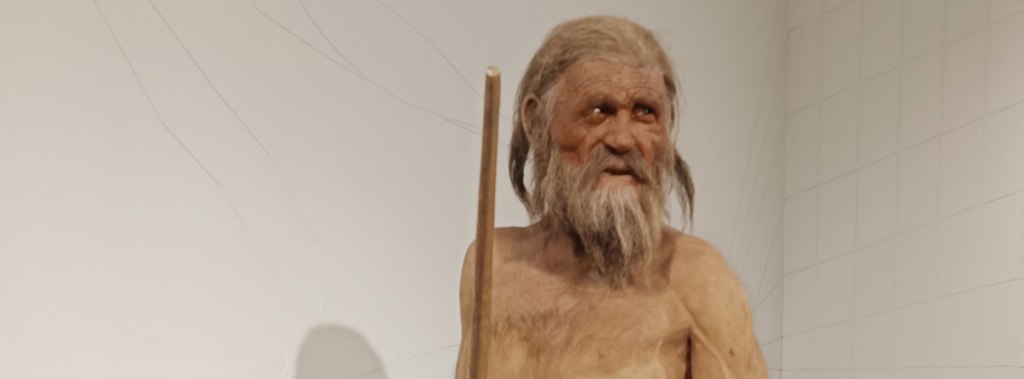
In 1991, hikers in the Alps spotted what looked like a doll frozen in the ice. It wasn’t a toy. It was a body. What police thought was a recent accident turns out to be something far stranger.
In this episode, Nate talks with author and journalist Brenda Fowler about the discovery of Ötzi the Iceman and the science that helped unravel his story. What can one frozen body teach us about early human civilization? Much more than you’d think.
Connect with The Show About Science:
Instagram: @showaboutscience
Facebook: @theshowaboutscience
YouTube:The Show About Science
Twitter: @natepodcasts
LinkedIn: The Show About Science
Threads: showaboutscience
Transcript
Nate: Hi, this is Nate. Welcome back to The Show About Science. Today’s episode starts in 1991.
Inside a car are two reporters driving back home from a vacation in Italy. They’re in Europe to report on the breakup of Yugoslavia. One is Brenda Fowler from The New York Times. The other, her boyfriend, works for The Washington Post.
On the radio, a news story catches their attention — something about a discovery high up in the Alps. They turn to each other and ask:
Brenda Fowler: Is this a story? Do we have to race back to Vienna to both write an article on this? And we’re like, no, let’s give it a few days.
Nate: This is Brenda.
Brenda Fowler: A few days later, this was still a big story, and I got super interested in it.
Nate: Today on the show, Brenda’s going to walk us through this mystery that scientists have been trying to unravel for decades. All right, let’s get into it.
The story that Brenda became obsessed with begins in the Alps, on a mountain range called the Ötztal Alps, located on the border between Austria and Italy. It’s home to breathtaking peaks and valleys, with trails that offer spectacular views of nature.
On one of these trails, a German couple, Helmut and Erika Simon, were hiking,
Brenda Fowler: Right along the top of a peak near the Similaun Pass. It’s a great place for hikers to go.
Nate: The Simons decided to take a shortcut down from the peak, where they spot something poking out of the ice. Something unexpected.
Brenda Fowler: They noticed what looked like a doll. They thought, “Oh, someone had dragged a doll way up here? That’s weird.”
Nate: But it wasn’t a doll. It was a human corpse, frozen in ice, lying face down in the snow.
The Simons were stunned.
Brenda Fowler: They were a little freaked out, but they had heard of hikers being caught in avalanches before — people being trapped in glaciers, falling into crevasses. They thought, “Oh my God, this is probably a poor hiker like us who had an accident. Poor guy — who could this be? Maybe someone’s relative is missing. We better go right away and report this.”
Nate: Not too far down the trail from where the Simons discovered the body was the Similaun Hut, a place where hikers, mountain explorers and skiers gathered.
Brenda Fowler: “Instead of investigating too much, they immediately went back to the little hut that was close by and started telling people there what they had found.”
Nate: News spread like wildfire. News reports start to emerge referring to him as the Iceman. But an Austrian journalist looking for a catchy name dubs him Ötzi after the Ötztal Alps mountain range where he was discovered. The name sticks.
Back on the mountain, police begin to arrive at the scene. They’re there to investigate and recover the body. There’s lots of speculation about who Ötzi is. Maybe he’s a dead hiker, or maybe a soldier who got stuck in the Alps.
Brenda Fowler: You know, maybe this person has been up here since World War II. Maybe it was a runaway from the Nazi army. I mean, they were coming up with lots of different things.
Nate: They were also noticing how well-preserved Ötzi’s body was. And that was unusual.
Brenda Fowler: This is a little grotesque, but normally if a hiker falls into a crevasse on a moving glacier, their body will be pretty much crushed and they will be carried down the mountain in the ice and their body gets kind of transformed into this waxy material and then they literally, like, melt out at the melting edge of the glacier way down low where it’s warmer. So everyone in the Alps who lives near glaciers has heard stories of people’s remains coming out of glaciers. But this guy was at the very top of this mountain pass and he wasn’t in a moving glacier. He was in, like, a little — almost think of it like a little pond of ice that was caught up there on a flat area. No, he wasn’t in moving ice.
Nate: So he didn’t get crushed at all?
Brenda Fowler: He didn’t get crushed. He was frozen in from the top of the shoulders all the way down to the feet.
Nate: They begin to dig Ötzi out of the ice, but he’s really stuck in the glacier. They’re able to dig out his hips, but his legs are still frozen in the ground. And while they’re doing all this work to free him from the ice, the investigators start to notice some unusual details.
Brenda Fowler: They started to notice that this person was wearing some leather clothing. They also noticed that there was no plastic. There was nothing but leather and grass. And around his waist, there seemed to be some things made of stone.
Nate: And would all those things be, like, pretty out of place for a hiking accident?
Brenda Fowler: Absolutely.
Nate: OK.
Nate: On the body’s torso are strange tattoos — a bunch of small lines across the lower back. Some unidentified items were also scattered around the site.
Brenda Fowler: A long piece of wood, some pieces of birch bark.
Nate: Most of these were tossed to the side and put in garbage bags so they wouldn’t interfere with the excavation efforts.
More people start arriving.
Brenda Fowler: One of the people who came by was a very famous mountain climber named Reinhold Messner. He’s a big, burly guy with a big bushy brown beard, and he lives, actually, in a castle.
Nate: Messner is most famous for summiting Mount Everest without an oxygen mask, and he’s considered potentially the greatest mountaineer of all time.
His castle dates back to the Middle Ages and is not far from where Ötzi was discovered.
Brenda Fowler: And he just happened to be arriving at the Similaun Hut where the Simons had gone to report this discovery, and he was really intrigued. So even though he had just spent a very long day hiking, he and his pal went back to the site. And his friend was, you know, pulling pieces of wood out of the ice and kind of poking at the body, and he lifted up the head to see if he could see the face.
Nate: Messner thinks Ötzi may even be older than World War I, possibly hundreds of years old. He alerts the press about this new revelation, and it quickly becomes front-page news across Europe.
Brenda Fowler: My boyfriend and I were listening to the news, and we heard them talking about how it might be a corpse from 500 years ago. And we looked at each other and we thought, “This is amazing!”
Nate: Later that day, they bring the garbage bags down to the nearby town. One of the local Austrian police officers takes out an item that resembles an axe. He scratches it with a coin and says, “Hey, this looks like copper.”
Two days pass. European experts of many fields are abuzz with the emerging facts of the discovery. Many think this discovery could be big. Forensics experts are pushing to get the body out of the ice so it can be more closely examined.
A forensics professor named Rainer Henn from the University of Innsbruck in Austria takes matters into his own hands. He travels up to the site of the body and, with a local policeman, digs Ötzi out of the ice with a ski pole and ice pick. They load the body onto a helicopter and bring it to the University of Innsbruck, where Ötzi is reunited with all of the artifacts that had been tossed in garbage bags.
Brenda Fowler: So the chief coroner was unpacking this big trash bag that contained all of the stuff that they had pulled out of the ice with him. And normally, he would be preparing to do an autopsy and looking for identification. But he realized immediately that this was not someone who was going to be carrying identification. There was nothing — I mean, except for the ax, there was nothing that he could be identified by. And so he immediately called over to the Department of Archaeology at the university to see who he could get over there to identify the time, you know, in which this man had been living.
Nate: On Sept. 24, five days after the discovery, Konrad Spindler, an archaeologist from the University of Innsbruck, arrives. He walks in, hardly looks at the body, but immediately picks up the axe.
Brenda Fowler: He came over and took one look at the shape of the axe and said, “This is from the Bronze Age. This is more than 2,000 years old.” And you can imagine everyone in the room, their jaw just dropped. “What? This is a Bronze Age discovery?”
Nate: OK.
Brenda Fowler: But actually it turns out when they did the analysis of the metal, it was made of copper.
Nate: Would that make it even older?
Brenda Fowler: Yes.
Nate: Wow.
Brenda Fowler: So based on the fact that it was copper and also based on the carbon dating that they did on the wood that was found with him, they dated him to about 5,300 years ago — so 3300 B.C.
Nate: OK, so really old.
Brenda Fowler: Very old. So copper was the first metal anywhere in the world that was mined expressly to make metal tools. So the Iceman’s axe is really interesting because you can’t just find copper lying around in that area. You have to trade for it. And we now know, based on isotope analysis of the metal, that the raw copper in his ax came from southern Tuscany. So that’s several hundred miles away.
Nate: So that’s telling you that not only do we have a kind of civilization there, we have a civilization that’s interacting across hundreds of kilometers and that’s able to facilitate trade to help better all the parts of that society, right?
Brenda Fowler: Absolutely right.
Nate: While Spindler was wrong about the metal in the axe, one person had been right all along.
Brenda Fowler: You know, the police officer in the tiny little town was like, “Told ya.” ’Cause I scratched it and it turned out I could see there was copper under there.
Nate: Everybody knows about the Bronze Age, but little is known about the Copper Age, which came before it. So this was a big deal. This singular discovery is the only glimpse we have into a whole forgotten era, a time a thousand years before the Great Pyramids were built.
And now that scientists know the magnitude of this discovery, a flurry of investigation begins. They use carbon dating to confirm his age. They do X-rays, CT scans. There’s paleobotanists, glaciologists, radiologists, archaeologists — all sorts of specialists are involved.
And after all of this inquiry, the prevailing theory about his death was that he had been in some sort of trouble, escaped into the mountains and died, probably because of the weather.
Brenda Fowler: The idea for this came from the fact that he wasn’t very prepared. He looked like he was in a rush because he didn’t seem to be carrying any food with him. That was really the going hypothesis for a long time.
Nate: Ten years go by with no new discoveries, but the questions persist. Who was this man? Why was he found where he was? And how did he die?
Brenda Fowler: Like, what was he doing up there? This is a place where you would never, ever want to be stuck if it was snowing. It’s life-threatening. You only go up there if there’s a really good reason.
Nate: While those big questions hung on ice, a surprisingly small detail would change the course of the investigation.
It was unclear whether Ötzi was discovered in Austria or Italy. For years, the two countries actively disputed which side of the border he had been found on. That question was resolved in 1998, when it was determined — after years of being on display in Austria — that the body had actually been discovered 100 meters into Italian territory.
So they moved him to Bolzano, a town in Italy, where research resumed under a new team of Italian scientists. There, an Italian radiologist reexamined the body using high-resolution technology.
Brenda Fowler: So when he was initially discovered, he was X-rayed. And the first radiologist who looked at it did not realize that there was a very interesting clue in his back.
Nate: These new scans revealed something that would stun everybody.
Brenda Fowler: All of a sudden, a little local radiologist, who finally was able to do his own X-rays, noticed that there was a very strange spot in his left shoulder. And when he examined it more closely, he realized that it was in the shape of an arrowhead.
Nate: Wow, OK.
Brenda Fowler: There’s no shaft attached to it. So at some point the shaft must have been pulled out, but it looked like it had pierced — actually severed — a main artery that runs under the collarbone. So it had entered from the back above the shoulder bone and ended up cutting through the subclavian artery.
Nate: Would there be any way that somebody could survive an injury like that?
Brenda Fowler: Not in those times. Now, if you get wounded there, there’s a chance that you can be saved, depending on how close you are to a trauma center.
Nate: Most likely, the arrowhead to the back was what killed him.
Brenda Fowler: That is what most of the scientists working on the project now think — that he was shot in the back, the arrow pierced above his shoulder, and he died from blood loss.
Nate: Wow. OK. So when this discovery happened, what was everybody who is familiar with this case thinking? And what were you thinking about it?
Brenda Fowler: Well, I will never forget the day I saw this news and I called my radiologist friends and I said, how did you guys — I mean, in a very polite way — are you surprised that an arrowhead was found on the images of his body? And of course they were very surprised and a little bit embarrassed. But to their credit, at the time when they took the first X-rays and the CT scans, there were a lot of concerns about doing too much to the body because they wanted to make sure that it was going to be preserved and available for further research. So they weren’t doing the most thorough CAT scans, the most thorough X-rays that they could do. They were working very quickly and they just thought, “We just got to X-ray something. We got to CT something right now.” They also didn’t have any experience with taking X-rays and CTs of a mummified body. It’s not the same as with a live body, which has a much higher, you know, component of water. So their settings would have been a little bit different, but they were people who were working in a hospital. They weren’t working as archaeologists.
Nate: OK. And was there any, like, evidence of a possible altercation that could have happened?
Brenda Fowler: They also know that on his right hand, they found signs that he had been fighting off an attacker or fighting off something. So what they see is that there are cuts to his right hand.
Nate: Like cuts that you would have if you were fighting off somebody with a knife or something like that?
Brenda Fowler: Right, exactly.
Nate: Yeah, OK.
This new revelation changed everything. With the discovery of the arrowhead, Ötzi’s final moments became much clearer, leading to two main theories.
So let’s go back in time. Let’s retrace the possible steps that most scientists think led to Ötzi’s demise 5,300 years ago.
Brenda Fowler: The most convincing hypothesis now is …
Nate: Someone tries to stab him with a knife.
Brenda Fowler: Probably at a lower altitude.
Nate: But he fights back, resulting in an injury on his hand.
Brenda Fowler: He’s gravely wounded.
Nate: He quickly grabs his most important items:
Brenda Fowler: A quiver, his bow, boots made of leather and stuffed with grass.
Nate: And then he flees into the mountains. Someone is tracking him. From a distance, they draw a bow, take aim, and shoot Ötzi in the back. The arrow cuts through one of his arteries. Injured, he looks for a place to hide.
Brenda Fowler: He took a little bit of shelter in this little indentation way, way up on the high mountain pass and died there and was covered by snow, later turned into ice. And then 5,000 years later, it melted and we had the Iceman.
Nate: But this theory doesn’t answer a crucial question.
Brenda Fowler: So why would he have chosen to escape if he were running away from some kind of fight in his native village? Why would he have stopped right there? Why would he have died there? Why wouldn’t he have gone to a lower altitude and tried to take care of his wounds?
Nate: This brings us to our second theory.
Brenda Fowler: And that is that we know that mountains are considered sacred in every culture. You know, when people live in mountains, they really worship their mountains. And for some archaeologists, it’s always been a little bit strange that somebody would have died right on this spot that was so high up. It’s a place that you can literally kind of see from the bottom of the valley.
So some people have always suggested that instead of him being a victim of an attack, that he was actually sacrificed on that spot, because these high mountain areas are so spiritually important to cultures. And when you drive through the Alps, or any mountain area, you’ll notice that people put monuments, crosses, flags on the mountaintops all around the world. And certain of them have really deep spiritual meaning — meaning that goes back literally thousands of years.
Nate: This also makes the items he was found with make more sense, as it’s very common across cultures to be buried with your most prized possessions.
Brenda Fowler: And what’s really interesting about that idea is that all of the artifacts that he has with him — all of his possessions — the quiver with the two arrows and then the unfinished shafts that he was working on, the unfinished bow, he had a little pouch with him. All of these things are things that you might argue you needed for the afterlife.
And then most importantly, being buried with your most impressive possession — which was, for him, the copper ax — that is a classic thing to put in someone’s burial.
Think of the Egyptian mummies. They had all of their jewelry, their gold. They even had servants buried with them — people that they would need in the afterlife.
So we’ll never probably know exactly what happened to this man, but there is still research going on into the possibility that it was a sacrifice. And I think once they do more and more thorough studies of other mountain areas there, we can see if there are more sacred sites at high altitudes.
Nate: Most scientists don’t think this is what happened, but it’s the theory that Brenda likes the most.
So the research into this man’s life continues, and we may never know the full story.
Brenda Fowler: This find is still absolutely unique. It’s just a really moving story of somebody who, for some reason, came to a sad end, but he’s helped us learn so much about what was happening in that area 5,000 years ago.
Nate: What we do know is that the Iceman is still on display in a museum in Italy. We’ve learned so much from Ötzi, and yet there’s still so much that remains a mystery. But if you go to his museum — like more than 250,000 people do each year — you can peer into his eyes and ponder, “What really happened to you?”
Brenda Fowler is the author of Iceman: Uncovering the Life and Times of a Prehistoric Man Found in an Alpine Glacier.
Thank you so much, Brenda. This episode would not have been possible without your diligent reporting and dedication to Ötzi’s story. A link to her book can be found in the description.
And thank you so much to Jason Paris for your initial editing notes and for all your encouragement along the way. This episode would not have been possible without you.
Music on today’s episode comes from Blue Dot Sessions, Epidemic Sound and the mysterious Breakmaster Cylinder.
All right, Dad, you can shut the recording off.

 The Show About Science
Leave a comment