
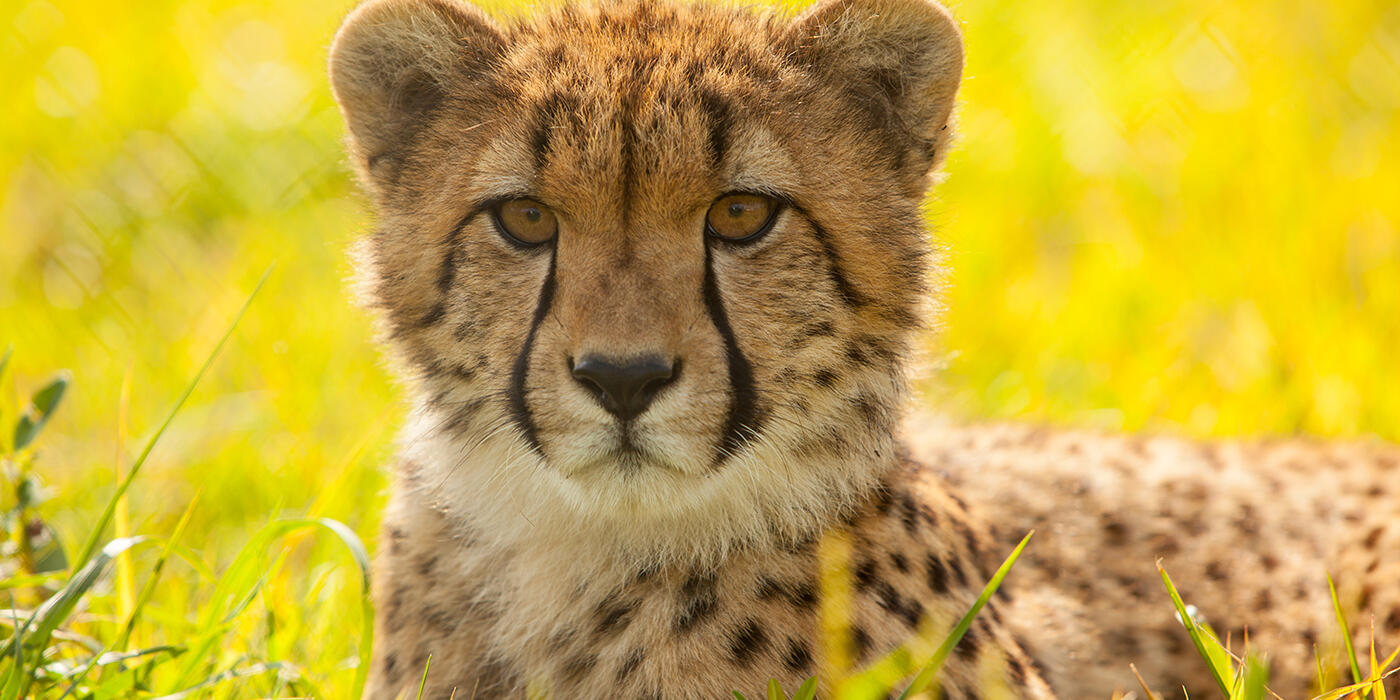
In this episode, Nate visits the Smithsonian’s National Zoo and Conservation Biology Institute in Front Royal, Virginia, to learn how scientists are working to protect cheetahs from extinction. He talks with carnivore keeper Amber Dedrick and program curator Adrienne Crosier about cheetah personalities, purring cats, genetic bottlenecks, microbiomes, fertility science, and the quiet work of saving a species one generation at a time. What does it take to help the fastest cat on Earth keep running? Find out on this episode of The Show About Science.
Subscribe to our mailing list: https://theshowaboutscience.com/#subscribe-submit
Watch the Tumble Joke-ha-thon: https://www.youtube.com/watch?v=x9eEdIwog_k&t=1s
Support Tumble: https://givebutter.com/JokeHaThon2026/natebutkus
Connect with The Show About Science:
Instagram: @showaboutscience
Facebook: @theshowaboutscience
YouTube:The Show About Science
Twitter: @natepodcasts
LinkedIn: The Show About Science
Threads: showaboutscience
Transcript:
Nate: Picture the fastest land animal on Earth, the cheetah. Zero to 60 in three seconds, but it’s losing the only race that matters, the one for its own survival. As humans turn wild grasslands into farms and ranches, cheetahs lose the space they need to roam, hunt, and reproduce. The animals they rely on for prey also begin to disappear.
Desperate, cheetahs go after livestock, causing farmers to kill them to protect their livelihood. Every cheetah lost is hard to replace, and fewer than 7,000 cheetahs are left in the wild. But here’s the thing that makes biologists most nervous. Even if the cheetah population were to recover tomorrow, each cheetah would still be carrying a problem inside its own body.
You see, tens of thousands of years ago, cheetahs nearly went extinct. So few survived that every cheetah alive today is descended from that tiny group, making them almost genetically identical. The result: lower diversity, weaker immune systems, and serious trouble reproducing. So if you wanted to save an animal like that, where would you even start?
This is your host Nate, and welcome back to The Show About Science The answer, as it turns out, is only about an hour and a half outside Washington, DC. Down a quiet road in Front Royal, Virginia, there’s a branch of the Smithsonian few people have heard of, the Smithsonian’s National Zoo and Conservation Biology Institute, or SCBI for short.
And as you pull up to SCBI, you might be surprised by what you hear. That cute, adorable sound comes from one of their cheetahs. Cheetahs’ vocal cords are actually much more similar to house cats than lions or tigers, so they meow, chirp, stutter bark, and purr. And at SCBI, there are a lot of these purring cats.
Amber Dedrick: We have a collection of 30 individual cheetahs here. Our larger breeding facility is about 8.6 acres, and we have 22 individuals that live at that facility. Our sister facility that’s just a little bit further down the road on campus has eight individuals. That’s Amber Diedrich, one of the carnivore keepers at SCBI.
Nate: Amber spends every day with these cats, and over time, she’s developed a personal connection with each cheetah. For me, they’re just so funny. I guess that’s hard to describe without, you know, having spent some time with them. And I will say that every single individual has their own personality, their own quirks, their own preferences, and it can be interesting for new keepers coming into the situation because if you don’t know them well, they all look like spotted cats, right?
Amber Dedrick: So- Mm-hmm … you have to learn pretty quickly to tell stripe patterns apart, to tell facial markings apart, to learn their personalities. that is a big part of taking care of them day to day, is being able to to, to tell them all apart by their personalities and their appearances. And some of the ones that I’ve been working with for a very long time, um, Sukiri is one of our cats.
She was partially hand-raised, so, you know, we have a special relationship with her. She’s gone on to have cubs and be a wonderful mom. And right now, we also have a litter of cubs that’s about seven months old. Their mother, Amabala, was born here at SCBI and grew up here and was one of those cats that I got to see have her own cubs and be successful.
So it’s been a great time watching her grow up and have her own cubs. Here at SCBI, the cheetahs have what’s been slowly taken away in the wild: room. Their own personal hunting grounds to roam, to hide, to just be cheetahs. So our enclosures are each pretty large. They’re all between a third and a half acre each, and we have a lot of trees and bushes and things like that in the enclosures.
Nate: That’s Adrienne Crosier, the curator who runs the cheetah program here And as it turns out, there’s a good reason why you’ve probably never heard of SCBI before. We are not open to the public here in Front Royal, and so we can have a lot of places for the cats to hide and just, you know, have their space, their peace and quiet.
Adrienne Crosier: They don’t need to be out and visible all the time. We also have what we call the tall grasses. It’s, um, clumps of really tall zebra grass, and they get to be even taller than me in the summer. And so the cats really love to get in the middle of those clumps of grass and have kind of their little almost, you know, den right there in the grass.
And we’ve had a lot of females take their cubs into those grasses when they’re very small. It’s a very quiet space. There’s not a lot of vehicle traffic. There’s not a lot of human traffic. It’s just very peaceful. SCBI was designed to mirror what life would be like for wild cheetahs as closely as possible, and that goes all the way down to the social groups the cheetahs live in.
So in the wild, cheetahs will live either solitarily, um, so females are always solitary in the wild unless they are raising cubs. Males live in groups called coalitions that are almost always litter mates. Um, sometimes a male will live alone if he doesn’t have any brothers or maybe if he’s lost his, his brothers or his coalition mates.
So we mimic that here in our facility as well. So, uh, most of our adult females live alone, and then we have family groups that are females with cubs of some age, and then the males all live in, coalition groups. So we have, quite a different variety of cheetah groups in our yards. It might be one cat, it might be five cats.
Nate: Okay, and do you know why males live in coalition groups, like in the wild, while females just live on their own? So living in a coalition definitely increases cheetah males’ ability to hold territory and breed with females and to hunt successfully. Cheetah females have extremely large home ranges, and so the males are more holding territory and the females are kind of moving through those territories.
Adrienne Crosier: So they don’t just bump into each other regularly for breeding. they have to do a lot of signaling and scent marking and things like that to kind of find each other. But having- Okay … having a, a coalition, having a group, it definitely increases those males’ chances of holding territory and having access to those females.
Nate: So in the wild, cheetahs barely even bump into each other. They’re spread out over this huge amount of space, and when it’s finally time to mate, it can be difficult for them to find each other. But at SCBI, they do not leave that up to chance. The team studies these cheetahs really closely, and I mean really closely, like down to the tiny living stuff inside their bodies.
Because as it turns out, if you want to save cheetahs, you have to understand them down to the very base level, both inside and out. So I asked Adrienne to talk about what that research actually looks like
What kind of research are you actually conducting into cheetahs while you’re working with them?
Adrienne Crosier: So we currently are working on several different research projects. Most of our research goes on for, for years and years. One of the big projects we are working on right now is associated with microbiome and looking at both the microbiome of the GI, so the microbiome in the cheetah’s stomach, intestines, um, everything in their GI tracts and how that influences overall health.
And then also looking at reproductive microbiome and trying to understand how that microbiome may correlate with fertility. Another big research project that we’re doing is associated with assisted reproduction. We do have fertility issues in several of our animals, so we do a lot of assisted reproduction, very similar to human medicine, to try to circumvent those fertility issues, things like artificial insemination and embryo transfer.
Nate: Okay. So before we kind of get into the fertility side of things, how does their microbiome impact them? So the microbiome can definitely change with different locations. So these animals certainly do move around from facility to facility. It can change with diet, it can change with overall health. So we’re trying to understand what a baseline, quote-unquote, “healthy” microbiome is for cheetahs of different ages.
Adrienne Crosier: So we’re still working on developing the baselines and establishing those for the species. And then we, we can also consider ways to change their microbiome if we find that certain aspects of it are associated with better GI health. Um, there are probiotics available that may or may not be adequate for what we need to do to alter the microbiome, but at least we would have a starting point to know what is included in a healthy microbiome.
Nate: Okay. And so then what would the difference between a healthy and an unhealthy microbiome be?
Adrienne Crosier: We’re really not sure. It could be different populations of families of bacteria or different levels of certain organisms. So it might be that there’s bacteria that are present or aren’t present that are needed, or it could be that one associated with a healthy GI tract just isn’t, there just isn’t enough of it in a certain individual.
Nate: Okay. And then how would having a, a healthy versus an unhealthy microbiome impact a cheetah’s behavior or, like, reproduction overall?
Adrienne Crosier: So the reproductive microbiome being kind of out of whack certainly could decrease their ability to reproduce and establish pregnancy in the females. We’re looking at correlations with those metrics in females, ability to establish pregnancy and produce healthy litters.
And in the males, we’re also looking at how the microbiome is associated with semen and sperm quality. So in that case, let’s shift it over towards the fertility side of things.
Nate: What are some of the ways that you’re trying to improve cheetah fertility and just overall increase the population of cheetahs in the world?
Adrienne Crosier: Well, we certainly do a lot of natural breeding. and then for our assisted breeding, we do a lot of artificial insemination, where we will stimulate a female with hormones through injections, just like a woman would do if she was undergoing artificial insemination or some of these other fertility treatments.
And then we deposit the sperm directly into the female’s oviducts and hopefully establish pregnancy. And then for the embryo transfer, we do fertilization in the lab and then transfer embryos to an appropriate surrogate
Nate: Okay. And then what is the Smithsonian doing to try to increase the genetic diversity of cheetahs? ‘Cause I know that’s another program that you guys are working on.
Adrienne Crosier: Yeah. So we work very closely with the Population Management Center of the Association of Zoos and Aquariums. So the PMC is the group that does the genetic evaluation on our population. We primarily use studbook data, so just like you would have studbook data on a horse or a dog, we keep studbook data for all of our animals.
Nate: A studbook is basically a giant family tree. It tells scientists which cheetahs are related and which ones aren’t.
Adrienne Crosier: And then using those relatedness data, we make recommendations for breeding, trying to reduce inbreeding and increase the reproduction of the animals in the population that have never contributed offspring.
So those rare genes from those individuals that haven’t yet reproduced are definitely, are higher target animals.
Nate: Okay. And is any of this impacting, like, the population of cheetahs in the wild, or is it all located in the zoo that you guys work in? Right now, we are not part of a reintroduction program to the wild.
Adrienne Crosier: There are other areas of the world that are reintroducing cats, mostly in Southern Africa and especially in South Africa. Mm-hmm. At some point, however, we may need to discuss the reintroduction potential of our animals in our population because the wild populations continue to decrease. So we wanna make sure that we keep the most genetically stable and healthy and outbred population as possible in our North American population.
Nate: Okay. So in that way, you guys are kind of acting as, like, a genetic bank in case the wild population gets to a point where they need that help from reintroduced cheetahs. Is that right? That is an excellent way to think of it, yes. Okay. So then is there anything that we as an audience or listeners can do to try to help the situation that’s going on there?
Well, I think the more education we have for everyone globally on the plight of not only cheetahs, but other animals in the African ecosystem and around the world that are undergoing the same type of conflict, can only help. So there are a lot of organizations on the ground assisting people living with cheetahs to help reduce that conflict.
Adrienne Crosier: It’s definitely made a huge impact in a lot of different areas. There’s a lot of conservation organizations, um, throughout especially southern Africa that are working really hard to reduce conflict and also to help study The cheetahs’, current natural kind of genetic structure as their home ranges have changed, understanding where the animals are dispersing, who’s reproducing with who, where those kind of land bridges are between these small fragmented populations.
Nate: And then what kind of role do cheetahs play in their ecosystem? Because I’m sure losing the cheetah population impacts more than just cheetahs. Absolutely. So they’re, um, a mid-sized predator. They use their speed to hunt. They’re not the strongest, but they are the fastest. So they definitely prefer prey, you know, that are kind of small ungulate size, but they will also hunt hares and, maybe even some birds.
Adrienne Crosier: They do hold kind of a unique place in the ecosystem in that they’re not the large predators like lions or even spotted hyenas. You know, they’re not gonna take down adult zebra and things like that. So- Mm-hmm … they do kind of target that mid to small size ungulate species.
Nate: An ungulate is just a hoofed animal. Think gazelle, impala, the smaller, faster grazers, not big stuff like a zebra. That gets into lion territory. But let’s take a step back. That little detail actually says something way bigger. Cheetahs fill a very specific, very important role as medium-sized predators. Lose the cheetah, and you don’t just lose a fast cat, you lose a thread in the whole web.
The balance of grasslands environments would shift forever, potentially leading to yet more important species going extinct. And whether these environments are still in balance 100 years from now might just come down to the quiet, patient work happening on a few acres in Virginia, and whether the rest of us decide cheetahs are worth saving Thank you so much for being on the show.
Thank you, Amber. Thank you, Adrienne. It was really fun getting to know cheetahs better with you.
Adrienne Crosier: Thanks for having us.
Nate: There you have it, folks. The show about science is complete. A big thank you to Amber, Adrienne, and Ellie Tamahseb at Smithsonian’s National Zoo and Conservation Biology Institute, and to Ben Marcus at the Smithsonian Institution. Today’s episode was produced by Jason Paris and edited by my dad. Our next two episodes will take you down the Panama Canal to the Smithsonian Tropical Research Institute.
You won’t want to miss them, so subscribe to our email list to be the first to know when they drop. Link’s in the description. And if you want to support science podcasting and watch an incredible dad joke tournament, check out the annual Joke-A-Thon over at Tumble on YouTube. No spoilers, but I may have made a pretty deep run.
They’ve raised over $40,000 so far, and there’s a link in the description if you want to support their fantastic work. Okay, Dad, you can shut the recording off.
Leave a Reply