
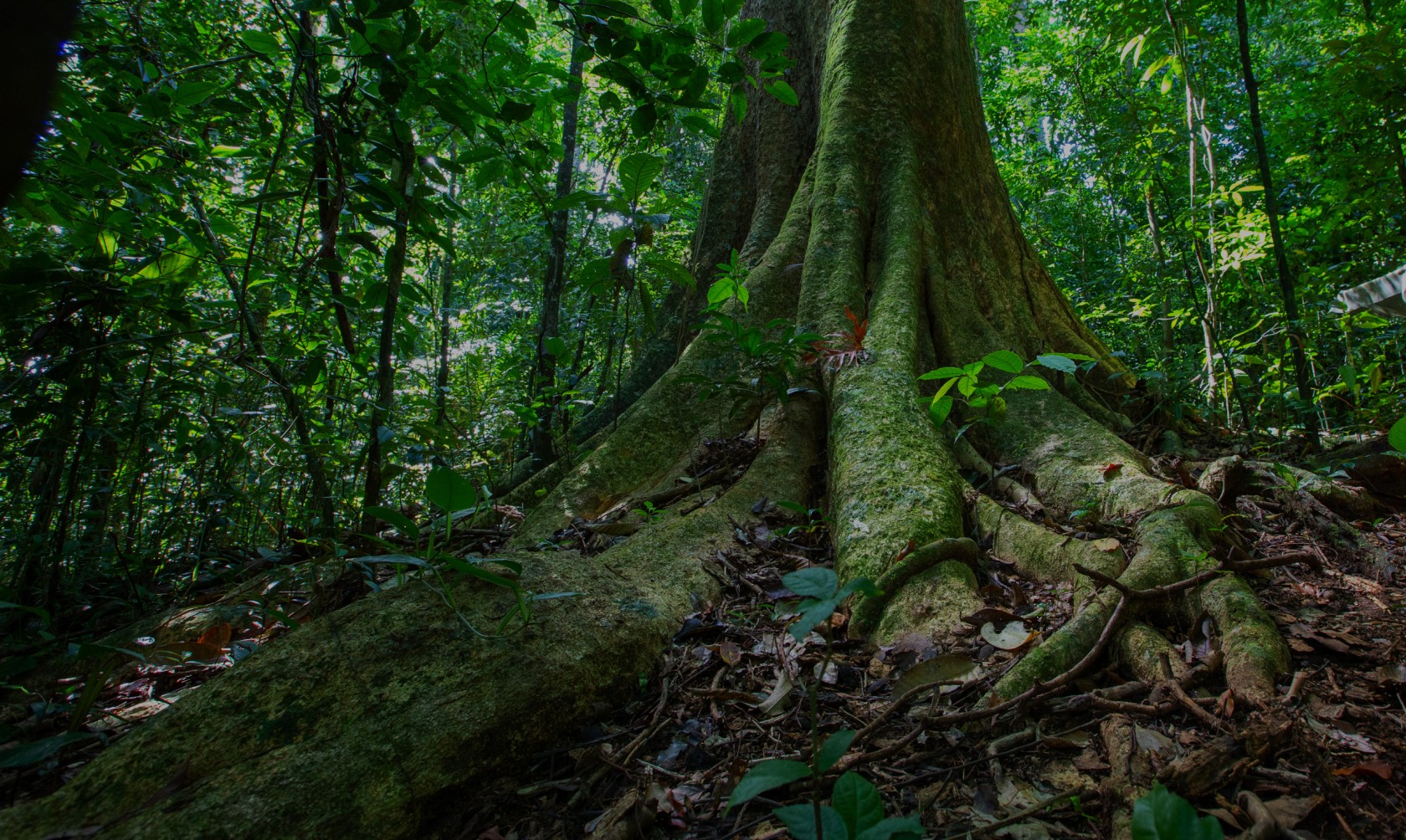
On Barro Colorado Island in Panama, scientists have spent decades tagging and tracking thousands of trees—watching which ones grow, which ones survive, and which ones die. Together, those trees hold clues to some of the rainforest’s biggest mysteries.
In Part 2 of our series, Nate hikes into the rainforest with biologist Erin Spear, who runs the Smithsonian Tropical Research Institute’s DEATH Lab and studies the sneaky, nefarious fungi that kill trees. The deeper they look, the stranger the story becomes: What’s bad for one tree might be good for the whole forest.
Subscribe to our mailing list: https://theshowaboutscience.com/#subscribe-submit
Connect with The Show About Science:
Instagram: @showaboutscience
Facebook: @theshowaboutscience
YouTube:The Show About Science
Twitter: @natepodcasts
LinkedIn: The Show About Science
Threads: showaboutscience
Transcript:
NATE: Hello, everyone. I’m Nate. This is The Show About Science.
Last episode, we ventured into the rainforest at night with biologist Rachel Page, who introduced us to some very noisy frogs.
On today’s episode, we’re going back up the Panama Canal to Barro Colorado Island. And this time, we’re venturing even deeper into the rainforest.
But as we hike into the forest, it’s clear that everything around us exists in a fragile balance. Our guest today is someone who studies that balance: Dr. Erin Spear.
Could you tell listeners a little bit about yourself?
ERIN SPEAR: Yeah. Well, first I’ll just say thank you so much for having me as a guest. It’s really awesome to be here. And I’ve also really enjoyed listening to your other episodes.
NATE: Oh, thank you.
ERIN: You’re welcome. I am a research biologist at the Smithsonian Tropical Research Institute, and I run what’s called the DEATH Lab. DEATH is an acronym for Disease Ecology Across Tropical Habitats.
NATE: Death. Which sounds pretty ominous.
And to be fair, Erin spends a lot of time thinking about things that kill trees. The strange part is, those killers might also be helping the forest survive.
To understand how, we need to climb a hill.
Remember, Barro Colorado Island used to be a hilltop. When engineers built the Panama Canal, they dammed the Chagres River. Water flooded the surrounding lowlands, creating Gatun Lake.
That hilltop became an island.
And the place we’re heading with Erin is right near the top.
ERIN: It’s a hill, not a mountain. When you’re hiking on that hill, it feels like a mountain because it’s really hot and really, really humid. And often it’s really muddy.
And then at the very top of the hill, there’s a plateau. And that’s actually where this really famous forest plot is, where we study forest dynamics.
So all of the trees in this 50-hectare plot are identified and tagged, and we can understand their growth and survival over time. That plot was created in the 1980s.

NATE: Wow.
ERIN: It’s as old as me.
NATE: Every tree here is identified and tagged. Scientists can track which trees grow and which trees survive. But Erin is interested in which ones die.
And lurking in the middle of all this life-and-death stuff are some of her favorite troublemakers.
ERIN: I mean, we’re really interested in the fungi.
NATE: Mm-hmm.
ERIN: We’re interested in how the fungi are interacting with the plants, the identities of the fungi living inside the plants, and everything about them: who they are, where they are, how they grow.
And so a big part of the research that we do is actually growing those fungi out of the plant tissue and establishing them in the lab so that we can do experiments with them. We can do DNA sequencing to identify them and understand things like how they respond to different temperatures, how they grow under those temperatures, and how that changes their dynamics with these plants.
NATE: Okay. And what are the fungi-plant dynamics that you’re observing? How do they interact?
ERIN: I mean, it really depends on the fungus. We don’t actually know how many fungi there are in the world. People think there could be, you know, three million different species.
I think right now there are about 150,000 fungal species that have been formally identified—like, have a scientific name. And very few of those fungi with scientific names are from the tropics, which is what makes it so exciting to work here. There’s just so much to be discovered.

NATE: Okay, yeah.
ERIN: And so some of them are interacting with plants in a beneficial way. Some of them are interacting with them in kind of a neutral way. They’re inside the plant but not really doing anything. They’re sort of hitchhiking, or they’re in the plant until they’re going to do something else.
And then some of them are—I mean, some people might call them evil. But really, everybody has good and bad sides. Some of them are what we call pathogens.
Pathogens are basically anything that infects another organism and then causes disease. Disease is formally defined as any time a normal bodily function, or the normal functioning of an organism, is compromised.
We all know about COVID. That’s an infectious disease that impairs a wide variety of things in human beings, including their ability to breathe. So that’s an example of a pathogen.
In this case, we have pathogenic fungi, which are what I’m really interested in. They do all sorts of things to the tree depending on whether they infect leaves, seeds, or roots.
But in leaves, they can cause super-beautiful patterns of yellow and red. Eventually, sometimes, the plant drops the leaf or the leaf completely dies.
They can also infect giant rainforest trees through the roots. Those fungi often do one of two things, or both. They go into the vascular system—basically, the internal piping of the tree—and clog it so that the tree can’t move water or nutrients up to its leaves and branches.
Some of them, once they get into the tree, start to consume the tree from the inside. And you actually end up with, instead of a solid cylinder for a tree, an empty straw.
Which obviously is not good for the tree. If there’s a lot of wind or something crazy happening, it makes the tree more likely to fall over or snap in half.
So those are some of the ways that fungi can impact trees and interact with them. Some other fungi interact with trees in really positive ways. They provide nutrients.
I like the sneaky, nefarious ones personally. But they’ve got a cool story, I think.
NATE: So what are you actually researching in terms of the sneaky, nefarious fungi? What is the cool story about those fungi?
ERIN: Okay. Well, the cool story has to do with this really famous hypothesis called the Janzen–Connell hypothesis.
These now-famous scientists—I don’t know that they were super famous when they came up with the hypothesis in the 1970s—they hypothesized that disease-causing fungi were the key to all of the different tree species in the rainforest. They allowed all of those different tree species to coexist, and they prevented any one tree species from becoming superabundant, basically hogging all the resources and excluding the other tree species.
And to give you an idea of how many trees are in a tropical rainforest, the whole country of Panama has about 3,050 different trees. I’m originally from Utah. Utah is a pretty big state—it’s about three times bigger than Panama—and it only has 50 native tree species.
NATE: Whoa.
ERIN: Yeah. So there are about 3,000 more tree species in tiny little Panama than there are in Utah.
As ecologists, we’re really interested in how all those species that are kind of doing the same things can coexist. When you think about plants, they sort of do the same thing. They need water, they need nutrients, they need space. Since they’re all making a living in the same way, how does that happen? How are they all able to make a living?
Like I mentioned, Janzen and Connell thought it was disease. What they specifically thought was that every tree species had its own unique disease. That unique disease would increase in abundance with the tree species, and eventually it would knock the population back. Because as the pathogen increased, it would kill more trees, the tree population would get knocked back, and that would allow all of these species to coexist.
But that whole hypothesis was based totally on the trees, without understanding the fungi at all. We were really like, no, we need to understand this from the fungal perspective. How can you ignore half of the players? And, as I’ve already mentioned, the coolest players.
And so we took what we know about fungi, and that guided our explorations. What we’ve actually found is that these trees are sharing all of their diseases, and that the fungi can infect a wide variety of different tree species.
Now what we’re trying to understand is: If the trees are sharing all of their diseases, what is helping maintain diversity? And what role are fungi playing?
The biggest thing that we think is going on is that even if several tree species share a disease, they’re differentially impacted by it. Some of them get the equivalent of the common cold, and others get these super-fatal outcomes where they end up dying from the disease.
We think that pathogen sharing—and the fact that the trees are not all equally likely to die—is what’s helping all of these tree species coexist.
NATE: Okay. So if one tree species were to start taking over, there might be a fungus that’s really deadly to it, that for most other tree species would just be like the common cold.
And since there aren’t as many of those other tree species for it to infect, it would infect more of the tree species that was taking over, and it would bring it back down to normal levels. Is that right?
ERIN: Yes. That is perfect.
NATE: Okay.
ERIN: You get a gold star. A lot of people can’t quite wrap their heads around it, but you nailed it. Your explanation was perfect.
And actually, those trees that are really likely to die tend to be these really fast-growing tree species. We describe them as live-fast, die-young tree species.
They’re not investing a lot of their resources in making defenses. Trees are not defenseless. They have all these things that they can do to prevent getting sick. One is that they can make their tissues really tough, really fast. Another is that they can make compounds to kill the fungi. Those compounds that plants produce end up being the source of a lot of medicines.
So trees have all these ways that they can counteract pathogens. But some species don’t even try to fight the pathogens. They just grow really fast and make their babies. They assume they’re going to be able to make their seeds and seedlings before the fungus kills them.
That’s their strategy: grow as fast as possible and don’t spend carbon and other resources on defenses against pathogens.
Those fast-growing trees tend to be in areas that have been disturbed, either by wind in a natural system or when people cut down a rainforest. They’re the first tree species to colonize that area.
And that’s really important. If we cut down forests and cause habitat destruction, it could lead to an increase in disease in the system because we’re basically helping these trees that are really susceptible to disease exist.
NATE: So if the fungi are helping create this kind of equilibrium of different tree species, where it’s very biodiverse, what does that do for the actual ecosystem that both the trees and fungi are living in?
ERIN: Oh, that’s an awesome question. I mean, where to begin? I knew this was going to be an issue. There are so many amazing things to tell you that I’m like, what do I focus on?
The rainforests are really good at holding sediment and water in place for the canal and making sure it’s deep enough for global commerce. But rainforests are also critical for keeping the world cool. They’re a really important carbon sink.
They take up carbon from the atmosphere and use it to make their tissue—all their leaves and branches. But they also do this thing called evapotranspiration. They suck up moisture through their roots, and then it goes up to their leaves. The leaves have these little pores, and moisture comes out of those pores when they open to take in carbon.
All of that moisture going from the roots back up to the atmosphere cools the air, kind of like a swamp cooler. It also seeds clouds, so it causes rain.
Those rainforests are super, super important to keeping the air cool and maintaining normal hydrological cycles. And, you know, plants produce oxygen—obviously important for us.
All of those different tree species are food and homes for all sorts of animals, including us. We eat a lot of the different things and use a lot of the wood and other things that come out of forests.
If we didn’t have all those different tree species, forests wouldn’t be able to provide all of those different roles. And they definitely wouldn’t be able to support all the different bats, monkeys, and everything else that’s on BCI.
So fungi—they’re ruling it all. They’re like the puppet masters back there.
NATE: Bringing order to the rainforest.
ERIN: Exactly. Exactly.
NATE: So what actually keeps the fungi that would kill a specific species of tree from running that population into extinction? What causes this equilibrium to emerge?
ERIN: Yeah, that’s a great question. These fungi aren’t like an insect or like us. They don’t have directed dispersal.
Basically, when they get into a tree’s tissue, they’re living their best life. They’re killing the tissue, they’re growing, they’re killing more tissue, and they’re doing such a good job that they’re reproducing. They’re producing spores from that tissue, which is like eating, partying—all of that kind of stuff—living the best life possible.
Those spores move from that location by wind or by being splashed by rain. The fungi have no control over where their spores—which are how more of them are produced—go. They’re kind of like seeds. And they tend to move a limited distance.

If they’re knocking back the number of trees of a certain species, at some point there are either none or only a few of those individuals left in that area. There’s basically nothing left for that pathogen to consume, so it will kind of blink out in that spot. And it can’t necessarily reach the other individuals that are far away.
As long as individuals of the tree species it likes consuming are far enough away from where it’s living its best life—killing a lot of tissue and making spores—the fungus will never get to them.
That’s basically how the tree population never goes extinct. That’s the idea. The fungi are what we call dispersal-limited.
NATE: So they might be harming the tree itself, but they’re an overall boost to the ecosystem.
ERIN: Exactly. What’s bad for one tree might be good for the whole forest.
NATE: Okay.
ERIN: That’s what I’m always telling people. It’s easy to think of these fungi as villains, but killing one tree gives life to all of these other trees. They’re destructors, but they’re also constructors.
NATE: So the fungi really are vital for the ecosystem’s health.
ERIN: Absolutely. Absolutely. The forest wouldn’t be what it is without the fungi. We wouldn’t be what we are without the fungi. Those forests are cooling the Earth and sucking up carbon, and we owe so much to them.
NATE: Tree-killing fungi seem like they should be a pretty clear-cut narrative. Fungi kill trees. Trees die. Fungi bad.
But that’s not actually the case. In reality, those same fungi might be one of the reasons this rainforest has so many different kinds of trees—and so many frogs, bats, monkeys, and everything else in this ecosystem.
Every little part of this place is interconnected. And that’s what scientists like Erin love about this island.
ERIN: Every day that I go to the island, I’m like, that was a really good day. I learn something new, I see something new, I appreciate something in a different way.
And I’m obsessed with my Fitbit. My heart rate is like 10 beats per minute lower when I’m on the island, which I think—yeah, that really conveys how happy and at peace I feel when I’m on the island.
And, yeah, it gives you a good sense of your place in the universe. At least for me, it reminds me how small I am, but in this really great way. I’m this tiny thing in this amazing, beautiful universe.
NATE: This episode was part of a two-part series about Barro Colorado Island in Panama. If you haven’t already, be sure to go back and listen to part one.
A very special thank you to Ben Marcus, Rachel Page, Erin Spear, and everyone at the Smithsonian Tropical Research Institute who helped make this series possible.
Music for this episode comes from Blue Dot Sessions. The Show About Science is hosted by me, Nate Butkus. This episode was produced and edited by Eric Butkus, with story editing by Jason Paris.
There you have it, folks. The Show About Science is complete. Thanks for listening, and we’ll see you on the next episode.
Dad, you can shut the recording off.
Leave a Reply